Breathe, Think, Do

We often hear that screen time is bad. It’s detrimental to a child and their learning process. I’m of the belief that there’s a great balance between personal interaction, reading, playing and screen time. For me screen time includes TV, movies and apps.

One of my favorite apps I have come across is: ‘Sesame Street Breathe, Think, Do.’ This app has children help a Blue Monster through challenges. For example, the Blue Monster has trouble tying his shoes and becomes frustrated. First, the child helps the monster take three deep breaths. Then, the child can pop bubbles which helps the monster think of three possible solutions. Finally, the child gets to choose which of the three options may best help the monster.

‘J’ really enjoys this app and it’s great at teaching him to stop and think through his challenges or frustrations. He breathes along with the monster. He has fun popping the bubbles and learns how different choices can be made when approaching a challenge.

There are so many great learning apps out there. You can learn letters, numbers, shapes, spelling, the list goes on. ‘J’ has loves playing these “games” and doesn’t even realize how much he learns from them.

What I love about Breathe, Think, Do is that it addresses daily challenges and feelings, which is a lot harder to teach. Especially for someone who has sensory difficulties.

Then again, I wouldn’t expect anything less from Sesame Street.

IMG_8389E23DA6AF-1

Mets Overload

This past weekend, we went to a Mets game. ‘J’ has been quite a few times in his 4 years and ‘Baby J’ went once last year. However, this was our first game of the season.

We went with my family which meant three kids 4 and under (my niece is right inIMG_2097 between the ‘J’s’). Knowing the kids probably wouldn’t sit through much of the game, we got seats in the highest section…also known as the boonies. Some more background for you: it was also one of the hottest days of the summer and the game started when nap time is normally happening for all three.

If you’ve been to a game, you know there are lots of announcements, plenty of loud music and crowd chanting. Being so high up, we were pretty close to the speakers. Within a few minutes, the first announcement was made and ‘J’ was freaked out. He wanted to leave and said it was too loud. Him and I went back down, found a shady spot out of the way on the next level down and had a little hot dog and french fry picnic. We talked through it, walked around a bit and he wanted to try again. I’m happy he tried two more times but it was still too much for him.

He definitely has a sensitivity to sound and certain things are very overwhelming for him. What we have learned is that if we keep talking to him and maybe get him to cover his ears, it can sometimes help. The thing that has helped the most has been letting him know there’s a way out and a safe space. We know the signs/cues from him and we don’t want to see him go into ultimate freak out mode especially if the sound is affecting him that much. Once we found a calmer/cooler spot, he was ok.

Eventually the sun started invading our seats and we all hung out on the next level down before heading home. Back in the day, we used to stay the whole game…or at least until the 7th or 8th inning. Now we never make it past two hours. We did manage to get some adorable pictures which was great!

Oh and by the way, ‘J’ was asleep as soon as we got out of the parking lot.

Below are two videos from Sensory Spectacle regarding auditory difficulties.


Doing Disney with Sensory Processing Difficulties

If you are someone with Sensory Processing Difficulties, the idea of Disney World can seem very overwhelming. I mean, it’s overwhelming for people that don’t have these difficulties.

‘J’ was born with Disney DNA. I worked there for two years and prior to that had already visited Disney World about 50 times. In my final three months of working there, my husband started working there as well, which is how we met. Years have passed and we’ve taken many trips on our own. However, at this point, ‘J’ has already been 7 times and ‘Baby J’ has been 3 times.

We tend to do Disney a little differently. We don’t try to see everything we possibly can for everyday we’re there. Growing up, it was my family vacation spot and it was treated like a vacation. We would go to the parks in the morning and at night, with a stop at the pool and usually a nap in the afternoon. This made the trip way more relaxing.

Since we’ve been so often, we’re happy with the idea of just being there. Anything we do there, any ride we go on or restaurant we eat in is great. But if things don’t go as planned, that’s ok too. This makes being the parents of a child with SPD a lot easier. Before becoming parents we already knew future trips would probably be on their terms and schedule. That’s even more true now.

IMG_8412

The last two trips have been very eye opening. Things we thought would trigger him, didn’t and things we didn’t see coming, did. On our last trip, he was all about the Magic Kingdom and on the trip we took last week, it was completely overwhelming and he preferred the other parks. We try to get Fast Passes to help with lines and stick to a go with the flow mentality. If he’s not feeling it, we don’t do it and it doesn’t affect our trip because we know we’ll be back.

However, I am well aware that this is not the case for most. People take a trip once or twice while their kids are young and want to make the most out of the experience. I’ve been doing some research since we got back and Disney, being the amazing Guest orientated company they are, are fully prepared to make anyone with SPD (or any type of cognitive or physical disability) as comfortable as possible.

Once you arrive in Disney,  visit Guest Relations. They will be able to assist you with any questions you have and ensure your stay is magical! When traveling with someone with SPD (even if it’s just to a restaurant), there are certain item that may help them, should they feel overwhelmed in a situation. Remember to include that on your Disney trip. You can also visit the Guest Services portion of the Walt Disney World website for helpful tips and information. Click here to view the Services for Guests with Cognitive Disabilities page. If you’re visiting a different Disney Park, you’ll be able to find a similar page on their respective sites.

Meltdowns will happen and those with (and without) SPD will feel overwhelmed by some of Walt Disney World. My advice would be: don’t be too afraid to try. That pixie dust has been known to work wonders. Perhaps you and your child will feel a connection to Disney you didn’t think was possible. Disney Cast Members are there to help, be sure to take it!

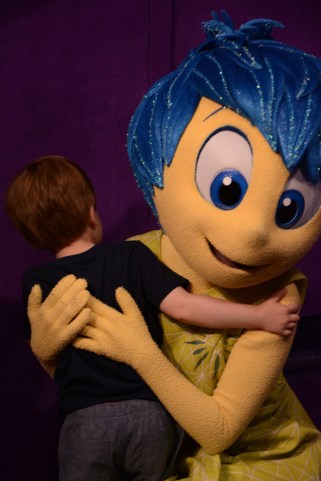
P.S. If you read my previous blog titled “Feelings,” than you know this picture with Joy was a big deal!

SPD in Teens and Adults

I often get asked if ‘J’ will grow out of his sensory processing difficulties. This is not something kids grow out of since it is a part of them. However, the work he is doing now and will continue to do will hopefully give him the tools to help him better handle his daily routine in the future.

The STAR Institute for Sensory Processing Disorder (SPD) posted a great article: “How SPD Affects the Out-Of-Sync Adolescent’s Emotions” by Carol Kranowitz, author of The Out-of-Sync Child. Click here to read the article.

Are you wondering what Sensory Processing Disorder may look like in adults? Click here to read all about it on additudemag.com. Thanks to social media, I noticed this article by the STAR Institute’s tweet!

Although kids and adults are affected by SPD differently, gaining insight is always helpful. Knowledge is power.

Be sure to check out the STAR Institute’s website  for more information about Sensory Processing Disorder.

STAR-Institute-logo

Sensory Processing Disorder and Autism

April is Autism Awareness Month and yesterday, April 2, was Autism Awareness Day. Although ‘J’ is not autistic and Sensory Processing Disorder is not Autism, many with autism also have sensory processing difficulties.

The following was taken from the Star Institute for Sensory Processing Disorder:

Children whose Sensory Processing Disorder conforms to the under-responsivity subtype typically require a great deal of stimulation in order to become alert and active, a behavior often seen in children with autistic spectrum disorders. Meanwhile, other children with ASD have symptoms more similar to the over-responsive subtype of SPD. Because Autism and SPD both have over-responding and under-responding categories, Autims and SPD are sometimes mistaken for one another.

The relationship between SPD and Autism is an area of great interest to scientists and families living with the condition. Studies by the STAR Institute suggest that at least three-quarters of children with autistic spectrum disorders have significant symptoms of Sensory Processing Disorder, and probably more depending on how significant symptoms are defined.

However, the reverse is not true. Most children with SPD do not have an autistic spectrum disorder! Our research suggests that the two conditions are distinct disorders just as SPD and ADHD are different disorders.

Appropriate intervention relies upon accurate diagnosis. Pursuing an evaluation for SPD by a qualified occupational therapist with sensory integration training facilitates diagnosis that distinguishes autistic spectrum issues from sensory issues. This distinction increases the likelihood that your child will receive the appropriate treatment for his or her neurological conditions.

With further research into the relationship of SPD and autistic spectrum disorders, the STAR Institute hopes to facilitate better more appropriate intervention for all children who have either – or both – SPD and Autism.

In The Out-of-Sync Child, Carol Stock Kranowitz writes “One of the major deficits of the child is difficulty processing sensory information. SPD underlies the child’s problems with coordination and balance, visual discrimination, and the ability to comprehend gestures, facial expressions, and social cues. For children with NLD, sensory integration therapy very beneficial.”

There are so many great resources available to those affected by autism. Click here to learn more from Autism Speaks.


Sensory Spectacle Resources

I am so thankful for Becky Lyddon, of Sensory Spectacle, for taking the time out of her busy schedule to be a guest blogger this weekend.

Sensory Spectacle is working to bring awareness to the Sensory Processing Difficulties community. Although based in the UK, they are providing information that spreads throughout the world.

If you missed this weekend’s 3 Part series from Becky, please click below for links:

Supporting a Sensory Lifestyle for People with SPD Part 1

Supporting a Sensory Lifestyle for People with SPD Part 2

Supporting a Sensory Lifestyle for People with SPD Part 3

Make sure to check out the Sensory Spectacle website and shop for more resources. Their presence on YouTube is so valuable for educating the public about sensory processing. I am thankful for having found the videos and being able to share them with family and friends. Click on the links below to follow Sensory Spectacle!

Sensory Spectacle Website

Sensory Spectacle Shop

Access and subscribe to the Sensory Spectacle YouTube channel

Follow Sensory Spectacle on Twitter

Follow Sensory Spectacle on Instagram

I’ll wrap up the series with this one video answering the question:

Why Do We Need to Provide Sensory Support?

Supporting a Sensory Lifestyle for People with SPD | Part 3 of 3

Tips for Supporting Someone with SPD

It is important you understand what someone’s over-riding sensory needs is. This will be the sensory system which they are mainly ‘seeking’ or ‘avoiding’ in their day-to- day lives. Once you can recognize this you can be prepared to support them in all settings.

I suggest that parents and professionals are prepared with a ‘sensory sack’. This bag will contain a selection of items that will support a range of sensory needs (don’t forget needs may fluctuate and vary):

  • noise cancelling headphones, either in the ear or over the ear
  • sunglasses
  • cap with a peak
  • something which smells of that person (old tshirt)
  • a soft fidget like a small cushion
  • a rough fidget like a brush
  • a fidget which you fiddle with
  • a weighted beanbag
  • electric toothbrush
  • a massaging cushion

Most children and adults with SPD are already regulating themselves so try and notice how they are doing that and offer other strategies too. You can learn more about understanding these characteristics with our ‘Homelife’ video series on YouTube. Subscribe and share the videos for FREE!

SPD is currently not able to be diagnosed in the UK in it’s own right, it is only recognized with an Autism diagnosis. SPD affects many other people with additional needs too though, so please bear this in mind. 

An Occupational Therapist who is Sensory Integration trained will be able to offer support and advice for anyone who has SPD. If you would like to help your setting become more aware of sensory needs then why not download our ‘What is SPD’ sheet from our website.

Supporting a Sensory Lifestyle for People with SPD | Part 2 of 3

Thank you again to Becky Lyddon, founder of Sensory Spectacle. Here’s is Part 2 of our 3 Part Weekend Series:

Sensory Spectacle creates immersive learning environments to help parents, professionals and students gain a unique insight into how SPD may feel for them and learn through empathy how best to personalize support for someone with SPD. Our Being Ben experience is based on a common difficulty of filtering out unnecessary sounds, Lola’s World is based on a visual processing difficulty of fragmentation and Mehdiosmia is based on a boy who found the smell of washing detergent too overwhelming to change his clothes.

There are 3 ways someone’s sensory processing may be affected. They could have difficulties with the amount of information they are processing – familiar terms for this are know as seeking and avoiding characteristics. Other people may have difficulties with working out the location or intensity of a sensation. And the third way is through motor-based difficulties. Often covering ears, squinting eyes, licking things, throwing objects, bumping into things, constant movement and eating a small selection of foods are characteristics we may commonly recognize and these are all relating to modulation – the amount of information someone is processing.

Our bodies need a certain amount of sensation to feel ‘OK’. We are constantly regulating ourselves and telling ourselves we are ‘OK’ we might need to help support people with SPD to do this but these characteristics mentioned above are some ways they are already supporting themselves.

Learn loads of fun and practical ways to support children and adults with SPD with our SPECTACULAR Play and Support guides which you can find on our website shop

Stay tuned tomorrow for our final part of the series from Becky’s piece on Sensory Processing and don’t forget to check out Sensory Spectacle at http://www.sensoryspectacle.co.uk/! 

If you missed Part 1 of our 3 part series, click here.

Supporting a Sensory Lifestyle for People with SPD | Part 1 of 3

I started this blog because of the information and solace I found in other blogs, articles and social media groups. I thought that maybe if by sharing my experience, it might be helpful for another parent going through similar situations. 

Thanks to social media, I came across other fantastic resources. One of those resources was Sensory Spectacle. I started following them on Twitter and watching their YouTube videos. I had reached out to Sensory Spectacle, which is based in the UK, to let them know how much I appreciate their videos and that I would love to link to some of them in my blog. To my surprise, Becky, the founder, offered to write a piece for my blog. I am turning her piece into a 3 part weekend series that begins today!

Thank you to Becky and all those at Sensory Spectacle for sharing this information and all that you do for the SPD community. 

And now, here’s Becky Lyddon, founder of Sensory Spectacle. 

I never quite realized how much I relied on my senses until I started a role as a playworker in London in 2009. After graduating from a degree in Graphic Design I realized an office based job just wasn’t’ for me. So I started a job supporting children and young people in a shortbreaks setting (afterschool, holidays and weekends). I got to do loads of fun activities and go on many holidays taking the children to places they had never been before offering new experiences for them and respite for families.

Being in a management role, as well as supporting the children I also had a responsibility to ensure my staff were confident and competent in caring for the young people in all settings we went to.

Very quickly after being in this role I realized that we didn’t offer any training to help them understand why some children may respond in a particular way to their surroundings. I wanted to make sure we could understand and care for the children as best we could. Often it was hard for staff to recognize triggers or understand why a child may love constantly flickering water, for example. Alongside this we also had many experiences where the public would ask us why a child played in a certain way or even if we could stop a child from doing something in particular.

I wanted to create a better understanding and awareness of Sensory Processing Difficulties (SPD) so I went and studied a Masters in Art & Science, it was here that Sensory Spectacle began making immersive learning environments for everyone to gain a unique insight from and to spread a better understanding and awareness of SPD. Our work is created based on descriptions from people with SPD.

Have you ever wondered how it might feel to hear all of the sounds in your environment right now while you are trying to read this post? The lights buzzing, technology whirring, radiators creaking, wind blowing, leaves rustling, airplanes flying, cars driving, footsteps moving, clocks ticking, conversations next door.

We all process and respond to our surroundings in a personalized way. Sensory processing is something which we all have in common as human beings. From before we are born we are sensing, processing and responding to information received from our senses. Because sensory processing is a personalized system unique to ourselves it is likely that you will have similarities in sensory preferences with your friends and family members as well as differences. Food choices, music preferences, sports activities etc. All of these activities revolve back to sensory processing and we build up these preferences throughout our life.

However for some people, organizing and responding to the sensory messages can be extremely confusing. Some children may cover their ears as they can be overwhelmed with the sounds around them. Or maybe you know someone who only has a diet of dry crunchy foods to help block out the sounds around them.

Sensory Processing Disorder (SPD) is when the brain finds it difficult to organize the messages it’s receiving and respond to them. Some people may respond to these sensations actively or passively. SPD impacts 1 in 20 and we must remember that this is throughout someone’s life so children and adults will experience difficulties processing sensory information. As children with SPD get older they are likely to find ways in which they support their own sensory needs in order to help regulate
their bodies.

We must try to understand what these sensory responses and characteristics mean so that then we can support personal needs. You can learn loads more about this in our workshops.

Stay tuned tomorrow for Part 2 of Becky’s piece on Sensory Processing and don’t forget to check out Sensory Spectacle at http://www.sensoryspectacle.co.uk/!
.
Squishy Fidgets

We’ve all heard of fidget spinners. It went from being a helpful aid for those with sensory disorders, autism and ADHD, to a hot holiday item that everyone wanted.

I never thought much of it, but in recent months I started to wonder if a fidget would be good for ‘J.’ I wasn’t sure where to start and didn’t feel like a spinner was the right answer for him.

I did some research here and there but never moved forward with the idea. About two weeks ago, ‘J’ started watching TV, reading books, etc. and I noticed his hands would be in his mouth pretty often. This was new and something I was keeping an eye on. I also noticed as he was playing play dough or some other toys he would be testing how it felt on his face. I wasn’t sure if he was requiring more sensory input or if something was bothering him. After talking with him and watching him more, I felt like at times he just needed to do something with his hands. I mentioned it to his Occupational Therapist on Monday and she suggested a fidget. During his session, she gave him a squishy fidget to play with. His hands never went in his mouth and he was excited to play with it. She said img_2017it’s something we could try and told me I could find them on Amazon. Easy enough! Amazon and I have a great relationship.

Right after OT, he has speech. I mentioned it to his speech therapist and she had a smaller fidget with her. She gave it to him to play with and mentioned it might help keep him still. Sometimes he gets…for lack of a better word…fidgety during his session. She also let him know that anytime he wants it, all he has to do is ask.

Now we our very own squishy fidget dinosaur (pictured here as he roars) and a few others to try out. I’m hoping this can be used for calming purposes when needed, gives him the sensory input he sometimes requires and of course for fun!

Click here to purchase the same squishy fidget toy for your family!