Jump Around!

What is the Vestibular Sense?

The vestibular system contributes to balance and orientation in space. It is the leading system informing us about movement and position of head relative to gravity. – SensoryHealth.org

There are times ‘J’ will jump on his bed at the end of the day. My immediate go-to is to stop him and explain how it’s time to get ready to sleep, not to play. But what he’s doing is bigger than playing. He’s giving his body what he needs in order to get to a more restful state. Yes, I know this seems like a contradiction, but trust me, it’s true.

I’ve been lucky enough to chat with Becky Lyddon from Sensory Spectacle on a few occasions and she is so awesome at explaining sensory life. I have mentioned her in previous blogs and I’ll be sure to link those below. For now, let’s listen to Becky explain the benefits of bouncing on a bed.

We have a trampoline in our backyard and ‘J’ could jump on it for hours. Over the years we have offered time on the trampoline when we can tell that it may be helpful in certain moments. Of course this is aside from just random playtimes when he’s bouncing as well.

I often have to remind myself that jumping on the bed is often exactly what ‘J’ needs and not something he’s doing strictly for the fun of it.

To learn more about the Vestibular Sense and your other 7 senses (yes there are 8), click here.

Previous Blogs Featuring Becky Lyddon:

A Hairy Situation

It’s Too Loud

Sensory Spectacle Resources

Magical Mommy Monday Episode

Amazon Prime Early Access for Sensory Items

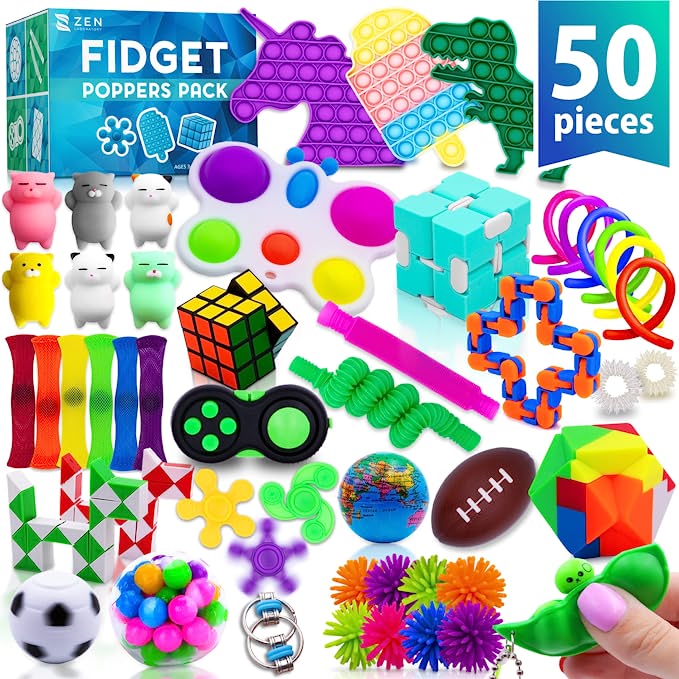
There are so many benefits to sensory items! They can help calm a child, regulate emotions, focus, enhance fine motor skills, improve language skills and so much more.

Amazon is currently running a Prime Early Access promotion today, October 11th and tomorrow, October 12th. Although the links below are affiliate links, they are products (or similar ones) we have in our home.

Click here to check out some of our favorite things!

Throwback Thursday

It’s October which means it’s Sensory Processing Awareness Month! I’ll be doing more posts in the coming days and weeks, but since it’s Thursday, let’s highlight some previous posts, #throwbackthursday style:

Click on the links below to read:

When Is It Empathy And When Is It Sympathy?

OT Approved, Now What?

The Mommy Gut

What is Sensory Processing Disorder?

Is This a Real Thing?

Be sure to check out more of our experiences in previous blogs!

Hitting the Reset Button

It’s so easy to get caught up in the craziness of day to day life. I feel like most have returned to making plans, seeing friends and family and being generally “busy.” As adults, we often find ourselves having to hit the reset button. Sometimes we realize we need to get more sleep, eat healthier, exercise more or set new goals. As parents, it’s important to know when we need a parenting reset or our kids need their own reset.

Sensory Processing difficulties can play tricks on you as a parent. You may think you’ve found your groove or have a good routine going. Maybe your kids have grown more and they’re able to express their feelings in a better way. You may even find they’re having more good days than difficult. But kids are little people that are evolving, changing and constantly trying to figure out the world. When we’re in a routine with school, activities and playdates, it’s easy to put that fact on the back burner. We’re just doing instead of making conscious efforts.

‘J’ is seven and a half and in second grade. He’s doing awesome in school. He loves his friends and teacher (and doing extra homework). He was fully virtual last year but did great adjusting back to in person learning. Being around new kids and seeing how they interact was a bit tough at first. He witnessed some rougher play, hitting each other, yelling in each other’s faces, all of which is not his personality. It definitely made him uncomfortable but he’s good about knowing right from wrong and over time started to understand varying personalities.

We’re in NY and this winter has been tough. Not too many days where we could be outside and play. This has an effect on him every year. As soon as the weather gets nicer, we’re outside daily and it definitely helps him regulate his body. With the colder temps, snow and rain, it’s not so easy. His mood is affected, his body is affected and eventually a light bulb goes off in my mind that it’s time to hit the reset button.

With ‘J’ getting older, how his SPD affects him has changed as well. He can spot if there’s a tag in his clothing that he wants cut out before he even wears it which is an improvement from a few years ago. If he’s frustrated or not getting his way, he can’t process how his body reacts to that emotion. Some adults aren’t good at dealing with their frustrations and he’s human, of course he’s allowed to be frustrated sometimes.

However, for him, he takes it out on himself. There’s negative self talk, he physically takes out his frustration on himself and as parents, it’s hard to watch. Especially when, prior to 6 months ago, he never did that.

The best thing we can do in these moments is to stay calm and keep ourselves regulated. No problem when your kid is hurting himself right? It’s not always going to be perfect but it has to be the goal or else the problem will just escalate.

For us, hitting the reset button meant taking a step back to make sure he doesn’t do anything dangerous while also not automatically reacting to everything he’s doing. It meant reminding ourselves that we need to stay calm in order for him to get back to that place too.

Bedtime was starting to get to be a struggle and I finally asked ‘J’ what was overwhelming him. He basically said he didn’t like being told what to do with the routine. So we said no problem, here’s everything we do before bed, how about you decide what you want to do first. This has been a game changer. The routine takes a little longer at night but we’re not in a battle anymore and that’s a huge win.

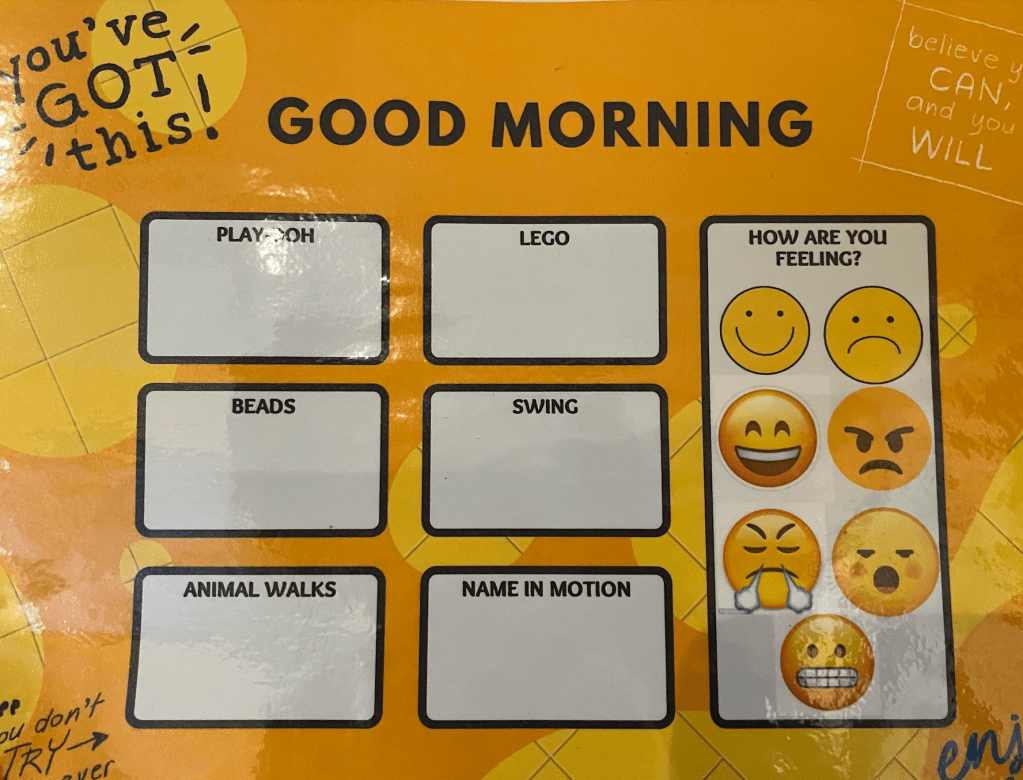
We also started incorporating sensory activities into our day again. This is one of those things that we can let slip when we’re so caught up in the day to day routine. Were we doing sensory activities some days? Yes. But not enough with conscious efforts behind it. We’re now having both kids choose what they want to do in the morning and in the afternoon on a chart. We have play-doh, beads, exercises, sensory swing time, reading a book in a rocking chair and others on the list. Some days we’ve brought their bicycles inside, put the training wheels in our shoes and let them pedal away to release some energy. They love this activity! They’ve used their imaginations to say where they’re going, what kind of adventures they’re encountering and who they may see along the way.

Going back to basics and remembering how important a sensory diet is (in whatever way you can fit it into your day), has helped mitigate some of those frustrating times. Of course they still happen and we will continue to work on different ways to get through those moments. Nothing will change overnight. It’s all about us as adults and our kids continuing to evolve, understanding emotions and figuring out ways to handle them.

A Karate Win

Yesterday was big! ‘J’ knows it and we know it.

If you’ve read this blog before, you know that ‘J’ has had struggles going into school and going to swim lessons. He got through them both, but it was difficult. Before the pandemic, we had attempted a Ninja Warrior class at the same place we used to take mommy and me classes. I thought he would love it. He loves to run, jump and create obstacle courses, this would be perfect!

It wasn’t.

Although I would be able to watch him during the class, a counter separated us which was too much of a separation for ‘J.’ There are things that we have to force him to do that aren’t easy for him: school, going to the doctor, etc. This wasn’t something he HAD to do, so we didn’t go back.

With some time having passed, we decided to try again this past spring. This time, his sister was also old enough for the class and I thought having each other would help.

It didn’t.

His sister however loved it and we signed her up for Ninja Warrior class, as well as Gymnastics. He came with us to watch her a few times and never felt like he was missing out. A feeling I never want him to have. He was ok with his decision which made us ok with it too. In the meantime, we found a LEGO challenge class online and most recently a virtual drawing class. He was comfortable with this set up, especially after a year of virtual school.

Their two best friends recently decided to try classes at the same location. I mentioned it to ‘J’ and asked if would want to try again, he said no and was still ok not being there. Then his sister, and two friends tried the Karate class. This was something we had offered to him before and something we knew he would like. He came with me as we watched the trial class. As he sat there, he kept saying “I wish I could do that too.” I said “You can! I’m sure they’d even let you try this class if you wanted to.” He said he wouldn’t be able to because he would cry. This was the first class where he felt like he was missing out on something. We talked about it as the week went on. I suggested we email the teachers to see if we could arrive a few minutes early, he can get comfortable there and try it out. Each day he went back and forth about it. In the meantime, I had emailed the teachers who have known both kids since they were babies (due to those mommy and me classes) and they said he could absolutely try it out.

‘J’ has gotten all in on Pokemon cards. There’s one in particular he wants and we decided to put it out there as motivation (a bribe?). If he got through 3 Karate classes, he could get the card. He still continued to debate whether or not he wanted to try.

This brings us to yesterday, the day of the class. We didn’t talk about it too much but it was known that today was the day. The kids played outside in the sprinkler, we had lunch, they showered up and we left early to go to class.

The fact that he didn’t get too nervous prior to getting in the car – a win!

We pulled into the parking lot and he said his belly hurt. I told him to take a deep breath and we were just going to do things one step at a time. We walked in, hung out a bit and the teachers said how excited they were that he was going to try the class. He sipped on his water and went in to play on the equipment for a bit. All classes start this way. Although he had made it as far as open play before, I still considered this a win.

I was a bit nervous knowing that his biggest hurdle would be when they officially started class and went over to the red circle for warm ups. The music turned off and the teachers said “ok come on over everybody!” And off he went.

This. was. huge. He was in the circle, warming up, sharing stories. My eyes were welled up. If he did nothing else today, I was so proud of him for getting this far.

He got through the entire class, no tears, no running away, never saying he couldn’t do it. He followed the instructor’s moves, went through the mini workouts and had fun doing it. His first trip out to me for a sip of water he pulled down his mask and said “Am I doing good?” I told him he was doing awesome and his eyes started to well-I told him to take a deep breath, he had this and he ran back in. At the end class, he asked for a uniform and his white belt.

When we got home, I talked to him one on one and asked if he was proud of himself. He said he was and that he had fun. I told him I was too.

This was the first time that we walked into a building and he never had hesitation from that point on. There were no tears, there was no struggle and in the end he was proud of himself.

Was it knowing his sister and best friends were in the class? Was it because this was a class he really wanted to do? Was it the bribe of a Pokemon card? Maybe it was coming off a Disney trip where he went on three big rides and had more confidence? I think a combination of all of the above.

I’m holding back tears writing this because of how monumental it is. I know other parents who have kids with daily struggles understand it. Small wins are wins. Big wins are mind blowing.

Oh, and he’s going back for gymnastics today!
Disney’s Disability Access Service Card

Back in 2018, I wrote about visiting Disney World with Sensory Processing difficulties. If you’d like to check out that blog, click here.

We just recently returned from a trip to Walt Disney World. As mentioned in that June 2018 blog, I knew that the Disability Access Service Card existed. For this trip, we decided we would play out how ‘J’ would do in the parks, knowing that this was an option.

Looking back, I’m wishing we did it from Day 1.

The first two days of our trip, we tried to wait on lines that were not too long, take our time moving around the park and getting in breaks during the afternoon. However, even on lines that we didn’t feel were too long (15-20 minutes), ‘J’ felt otherwise. He was extremely overwhelmed waiting on line, in a crowd and felt it would take much longer than we were telling him.

If you’re a parent with a child that does not have sensory processing difficulties, you may be thinking: ‘ok but no kid wants to wait on a line in Orlando summer heat.’ And you’re right! And I don’t like it either. But for ‘J’ it’s different and his reactions to it are different. Just like any other day to day activities that may appear easy for us, they’re not always easy for him. This goes under that same umbrella.

So what is the Disability Access Service (DAS) Card? According to the Disney Parks Blog:

The DAS Card is designed to accommodate guests who aren’t able to wait in a conventional queue environment due to a disability (including non-apparent disabilities). DAS will be issued at Guest Relations main entrance locations and will offer guests a return time for attractions based on the current wait time. As soon as the Guest finishes one attraction, they can receive a return time for another. This service can be used in addition to Disney’s FASTPASS Service and Disney FastPass+ service.

On the third day of our trip, we headed to Hollywood Studios and went straight to Guest Relations. I explained that ‘J’ had sensory processing disorder and found the lines to be…and then the Cast Member finished my sentence with: overwhelming? She took us over to the side and set us up with a DAS from her handheld device. We were told that we would need to go to a specific attraction to get a return time and that the pass would be good for the entire trip. We wouldn’t need to go to guest relations each day to have it set up again.

This pass was a game changer! I could see a weight lifted off of ‘J’ as we went to different rides. He was calmer, less stressed and more excited. Isn’t that how it should be at Disney?

I’m so thankful to Disney for accommodating all of their guests and for their amazing service helping us to obtain our DAS.

If you’d like to learn more, visit the Disney Parks Blog or reach out to Disney Guest Relations!

Overloads and Reactions

Every child with SPD is going to handle a sensory overload differently. This makes sense since the causes can vary, why wouldn’t the outcome?

For ‘J,’ there are so many things that can affect how he reacts to a situation where he’s uncomfortable. Sometimes it’s making a loud noise, other times it’s an actual scream. He could break down crying, get fidgety, act out or sometimes just give me a look where I can see he just needs some reassurance.

Most of the time we can be proactive in situations and deter whatever may affect him. At the very least, we always try to prep him from what he may see, hear or experience in any situation. If you’ve read this blog before, you know he’s huge on routine, so having a heads up to something new is always helpful.

Of course with a scream, people around us (family, friends, strangers) will notice. Being fidgety, acting out or giving us a look can be trickier. We know that he’s uncomfortable and we’re trying to get a handle on it or make it ok while those around us are clueless.

As I’ve talked about before, because SPD isn’t something you can see, people don’t always think through their actions because to them, ‘J’ often appears carefree. Someone we know might invite us to a big party, which is great and usually ends up being fine but we also know that ‘J’ will never be 100% comfortable. Others may play loud music, change up a routine, or try to play around by surprising him. His reaction can definitely run the gamut in these instances from giving a look to an all out meltdown.

When this isn’t a part of someone’s ever day life, it’s not a natural instinct to think through the moves you make. But taking an extra minute to think through actions can make all the difference to someone with sensory sensitivities.

Not Understanding Doesn’t Equal Not Existing

Sometimes when people don’t understand things, their automatic go-to is that it doesn’t exist.

When a person breaks their arm, you can see it. You know how it gets fixed and before long, the arm is back to new. With other conditions such as anxiety, depression or in my world, sensory processing difficulties, you can’t see it. There’s no cast to put on, and if someone hasn’t experienced it on some level, they’re not going to understand it. But, it doesn’t mean that it doesn’t exist.

I’ve talked about this a little in a past post, “Is This a Real Thing?” I’m sure I’ll talk about it again in the future because it’s an ongoing conversation. Being a part of various social media groups, I read so many stories of families not being supportive of a child with sensory processing difficulties. Often the parents will hear that they don’t discipline enough or that their child needs to learn respect. Sometimes a spouse doesn’t understand what’s going on, is scared of what others will think and therefore rejects the idea of an evaluation. When really, the sooner you get your child the proper therapy he/she needs, the quicker they will begin to thrive.

I don’t think everyone in our world fully understands what ‘J’ is going through or even what it all means. But they are supportive and only want the best for him. We’re still learning everyday. I’m lucky to have a spouse that is on the same page as I am and we work through it all as a team. I feel for those who don’t have the support since it’s stressful enough on it’s own.

There is plenty to catch up on from the couple of months I’ve been away from blogging and we will definitely get to it all!  A person won’t be cured sensory difficulties, but they can be given tools to help them through everyday instances that most of us take for granted. I hope those that are starting off without the support they need, eventually find it.


Another Hairy Situation

Back in April I wrote about how much J did not enjoy getting his hair wet or having it cut. Here we are in October and not too much has changed.Bath time has gotten easier, although he still has his moments. We still can’t wet a brush or comb when styling his hair.

Before school started, I took him to get a haircut. We made multiple attempts in multiple locations and none of them ended well. He was crying, screaming and trying to run away. It got to the point of his hair being in his eyes that we knew we had to try a different route before school started. My husband took on the duty of adding stylist to his resume. It was a struggle and took over an hour, but ultimately J had his hair in a much better state than he started with.

Hair grows fast. This weekend we found ourselves once again in the position of needing to take J to get his hair cut. We figured we’d skip the struggle of getting it done somewhere and just have my husband do it again. Needless to say, it didn’t go well (not horrible but could be better) and we will definitely be going back to the professionals for next time.

Click here to read “A Hair Situation,” which I posted back in April. I also included 3 videos from Sensory Spectacle in the post discussing why those with SPD find washing, brushing and cutting hair difficult.

Since we’re discussing hair cuts again, I have included that video below. What may not be fun for some kids is heightened for those with sensory difficulties. 

Change of Weather

I have horrible allergies and sinus issues. These get worse when the seasons are changing or if there’s rain. I’m also not myself if it’s a rainy day. I think many others are like that too, right? How many times do you hear ‘it’s a perfect day to stay in and watch movies.’ Knowing all of this, I shouldn’t be surprised that I notice a change in ‘J’ on non-sunny days.

IMG_3938.jpg

When trying to pinpoint when I noticed the shift, I think it was last year during a windy day. He was having more meltdowns, seemed tired and overall was not himself. I couldn’t quite figure out what was going on until the next windy day when it happened again. Over time, I picked on cues from him on cloudy days, rainy days, a major shift in temperature, etc.

For those with sensory processing difficulties, a change in weather also means a change of clothing. Many people don’t enjoy socks on their feet or sweaters. They may feel overwhelmed in a jacket or get overheated easily with too many layers. We have these experiences on a smaller level, as ‘J’ is not a fan of tags in his clothing.

Sometimes what may not be a big deal for us or something we’ve gotten used to, will be a much bigger deal for someone with sensory processing difficulties. I hope all those that experience more difficulties during weather changes, have a smooth transition as we go from Fall to Winter!

One more thing: I should also mention that almost everyday, when we open the front door to leave the house ‘J’ will say “wow! it’s a beautiful day outside!” even if it’s not. Sometimes he can be a glass half full kind of kid.