Anticipation

When I started this blog, I came up with the title “Just My MomSense” because I’m a big believer in trusting your gut.

No one knows your child better than you. This kicks in as soon as they enter the world. You start learning which cries mean hungry or indicate they’re in pain. You start to know by the looks on their face if they’re sick and as they get bigger, you can tell by a look on their face if something bigger is going on.

As a third grader, we have to trust our gut in new ways with ‘J.’ He’s always been big on keeping things bottled up but those feelings end up coming out in different ways. We don’t want this to be a norm for him and try our best to give him the tools he needs to express how he’s feeling. For example, we know there have been times things happen at school but he didn’t say anything because he wasn’t sure who to tell or when or didn’t want to interrupt the schedule of the day. We continue to let him know how important it is to speak up and to let someone know how he’s feeling because no one can help him if they don’t know what’s going on.

We’re all about the tools in this house and always have been. For us, therapies have been helpful because they give him more tools for his toolbox to get through his day. I’ve talked before about how things that so many people take for granted throughout their day are tougher for him, so the more tools to help, the better.

One of our tools, as parents, is anticipation. Maybe that isn’t the best word, maybe preparation is better…probably both. We do are best to anticipate and prep him and his sister for upcoming activities. We show pictures, videos when possible, or just explain an itinerary in detail. This helps to avoid fear of the unknown and soften any anxiety that could arise. We also try our best to anticipate how they’re doing in any situation. We can see a look on their face and know they’re uncomfortable or tired or starting to get anxious. When that happens we can pull them to the side or distract them or we can also leave the situation we’re in. It all depends.

Are we perfect at preparation and anticipation? Nope. Do we screw up sometimes and then have to think about why they’re acting a certain way? Yup, plenty. But we try our best and as parents, that’s all we can do.

Having a child with a speech delay and sensory processing difficulties has changed the way we parent both of our kids, more on that in the next blog!

Throwback Thursday

It’s October which means it’s Sensory Processing Awareness Month! I’ll be doing more posts in the coming days and weeks, but since it’s Thursday, let’s highlight some previous posts, #throwbackthursday style:

Click on the links below to read:

When Is It Empathy And When Is It Sympathy?

OT Approved, Now What?

The Mommy Gut

What is Sensory Processing Disorder?

Is This a Real Thing?

Be sure to check out more of our experiences in previous blogs!

CDC and AAP Milestone Update

I’m going to be honest. I’ve been writing a few blogs that I was planning on releasing, with a set schedule in mind in order to get back into the blogging game. However, this week the CDC and AAP released an update to their milestone guidelines and I thought, how could I not discuss this current news item?

If you’re new here, please know that I am just a mom and my opinions are coming strictly from that perspective. My son had an expressive speech delay and didn’t talk until two and a half. You can read more about that here. At three, we had him evaluated by an Occupational Therapist for Sensory Processing Disorder. I discussed that in another previous blog: ‘When Is It Empathy and When is it Sensory?’ All this to reiterate that I’m speaking strictly as a mom that has dealt with delays in developmental milestones.

The goal of the CDC and AAP is to help catch developmental delays, as well as Autism, earlier. But as any parent knows, nothing is one size fits all when it comes to kids.

When we were starting to question our son’s speech delay, everyone had an opinion, with the best intentions of course. We heard “oh he’s fine, just give him time” or “so and so didn’t talk until 3, he’s fiiiiine” and of course “he’s perfect, you have nothing to worry about!” As first time parents, our guts were saying one thing but everyone around us was saying another. When he turned 2 in June, his doctor mentioned we could look into having him evaluated or give him a few months to see if it just clicks one day. We gave him two months and decided to go with the evaluation.

On the flip side, our daughter said “Banana” which sounded like “Ah-na-naaaa” as her first word, at 12 months old. From that moment on, she was off and running with talking.

Our son walked at 14 months, where our daughter walked closer to 18 months. Two kids, from the same house, hitting milestones at different times. No one child is the same and they will all develop at different times.

The guidelines are just that and shouldn’t be something that parents feel have to be followed exactly. The updates have certain milestones pushed back, with others pushed ahead. I’m sure doctors, speech therapists, occupational therapists and physical therapists all have their opinions. Here is the one thing I know for sure: trust your gut!

The exact reason I started this blog was to share our experience in hopes of helping others while focusing on that gut feeling. It’s the feeling you have as a parent, because only you know your child best. For me, I refer to it as my “MomSense.” If you are working with a pediatrician that you feel is a good fit for your family, will listen to your concerns and take them seriously, offers advice without being pushy and will care for your child with good bedside manner all while trusting your gut, you and your child will be fine.

You are the number one advocate for your child always. If you feel your child might have a delay, the sooner you have them evaluated, the sooner they have tools in their toolbox to get them through the day to day. Walking, talking, crawling, stacking blocks and so many other things can be easily taken for granted. Family, friends and societal stigmas (which shouldn’t exist but unfortunately do) can sometimes get in the way of what you know to be true.

With these new guidelines, or any others, talk to your doctor and trust your gut. It will not steer you in the wrong direction.

You can read the updates to the Milestone Guidelines, by clicking here.

A Karate Win

Yesterday was big! ‘J’ knows it and we know it.

If you’ve read this blog before, you know that ‘J’ has had struggles going into school and going to swim lessons. He got through them both, but it was difficult. Before the pandemic, we had attempted a Ninja Warrior class at the same place we used to take mommy and me classes. I thought he would love it. He loves to run, jump and create obstacle courses, this would be perfect!

It wasn’t.

Although I would be able to watch him during the class, a counter separated us which was too much of a separation for ‘J.’ There are things that we have to force him to do that aren’t easy for him: school, going to the doctor, etc. This wasn’t something he HAD to do, so we didn’t go back.

With some time having passed, we decided to try again this past spring. This time, his sister was also old enough for the class and I thought having each other would help.

It didn’t.

His sister however loved it and we signed her up for Ninja Warrior class, as well as Gymnastics. He came with us to watch her a few times and never felt like he was missing out. A feeling I never want him to have. He was ok with his decision which made us ok with it too. In the meantime, we found a LEGO challenge class online and most recently a virtual drawing class. He was comfortable with this set up, especially after a year of virtual school.

Their two best friends recently decided to try classes at the same location. I mentioned it to ‘J’ and asked if would want to try again, he said no and was still ok not being there. Then his sister, and two friends tried the Karate class. This was something we had offered to him before and something we knew he would like. He came with me as we watched the trial class. As he sat there, he kept saying “I wish I could do that too.” I said “You can! I’m sure they’d even let you try this class if you wanted to.” He said he wouldn’t be able to because he would cry. This was the first class where he felt like he was missing out on something. We talked about it as the week went on. I suggested we email the teachers to see if we could arrive a few minutes early, he can get comfortable there and try it out. Each day he went back and forth about it. In the meantime, I had emailed the teachers who have known both kids since they were babies (due to those mommy and me classes) and they said he could absolutely try it out.

‘J’ has gotten all in on Pokemon cards. There’s one in particular he wants and we decided to put it out there as motivation (a bribe?). If he got through 3 Karate classes, he could get the card. He still continued to debate whether or not he wanted to try.

This brings us to yesterday, the day of the class. We didn’t talk about it too much but it was known that today was the day. The kids played outside in the sprinkler, we had lunch, they showered up and we left early to go to class.

The fact that he didn’t get too nervous prior to getting in the car – a win!

We pulled into the parking lot and he said his belly hurt. I told him to take a deep breath and we were just going to do things one step at a time. We walked in, hung out a bit and the teachers said how excited they were that he was going to try the class. He sipped on his water and went in to play on the equipment for a bit. All classes start this way. Although he had made it as far as open play before, I still considered this a win.

I was a bit nervous knowing that his biggest hurdle would be when they officially started class and went over to the red circle for warm ups. The music turned off and the teachers said “ok come on over everybody!” And off he went.

This. was. huge. He was in the circle, warming up, sharing stories. My eyes were welled up. If he did nothing else today, I was so proud of him for getting this far.

He got through the entire class, no tears, no running away, never saying he couldn’t do it. He followed the instructor’s moves, went through the mini workouts and had fun doing it. His first trip out to me for a sip of water he pulled down his mask and said “Am I doing good?” I told him he was doing awesome and his eyes started to well-I told him to take a deep breath, he had this and he ran back in. At the end class, he asked for a uniform and his white belt.

When we got home, I talked to him one on one and asked if he was proud of himself. He said he was and that he had fun. I told him I was too.

This was the first time that we walked into a building and he never had hesitation from that point on. There were no tears, there was no struggle and in the end he was proud of himself.

Was it knowing his sister and best friends were in the class? Was it because this was a class he really wanted to do? Was it the bribe of a Pokemon card? Maybe it was coming off a Disney trip where he went on three big rides and had more confidence? I think a combination of all of the above.

I’m holding back tears writing this because of how monumental it is. I know other parents who have kids with daily struggles understand it. Small wins are wins. Big wins are mind blowing.

Oh, and he’s going back for gymnastics today!

A Sensory Evaluation: Take 2

During his Kindergarten year, ‘J’ received Occupational Therapy at school. His Occupational Therapist (OT) was awesome and we stayed in contact to keep each other in the loop. However, occupational therapy in school typically focuses more on fine motor skills (ie: handwriting) and whether or not the student cannot focus in class. ‘J’ was doing great in both of these areas. Unfortunately, the school could not provide more assistance when it came to sensory difficulties. They did not have the space or types of therapies to assist students in this way. It was recommended that ‘J’ would not receive OT for 1st grade.

Knowing that ‘J’ struggled with lighting, sounds and still had separation anxiety during morning drop off, we had him evaluated by an outside OT. He was evaluated at the end of February, 2020 in the areas of Touch Processing, Visual, Oral, Movement and Motor. Without going into specific details, he received scores under the categories of “More Than Others” or “Much More Than Others.”

It was recommended that ‘J’ receive occupational therapy for help reduce sensory sensitivity in the area of auditory, touch processing, visual, oral and sensory seeking behaviors. There would be focus on strategies to help reduce anxiety in social settings, to make him become more comfortable with challenges and to adapt to given situations within his life.

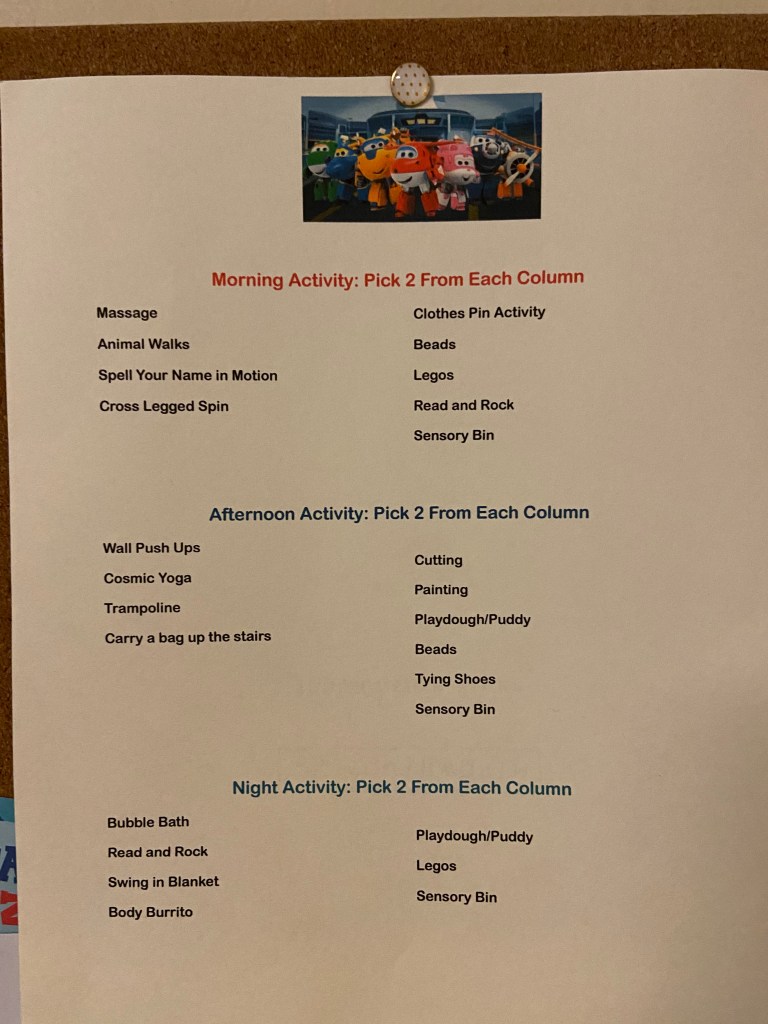
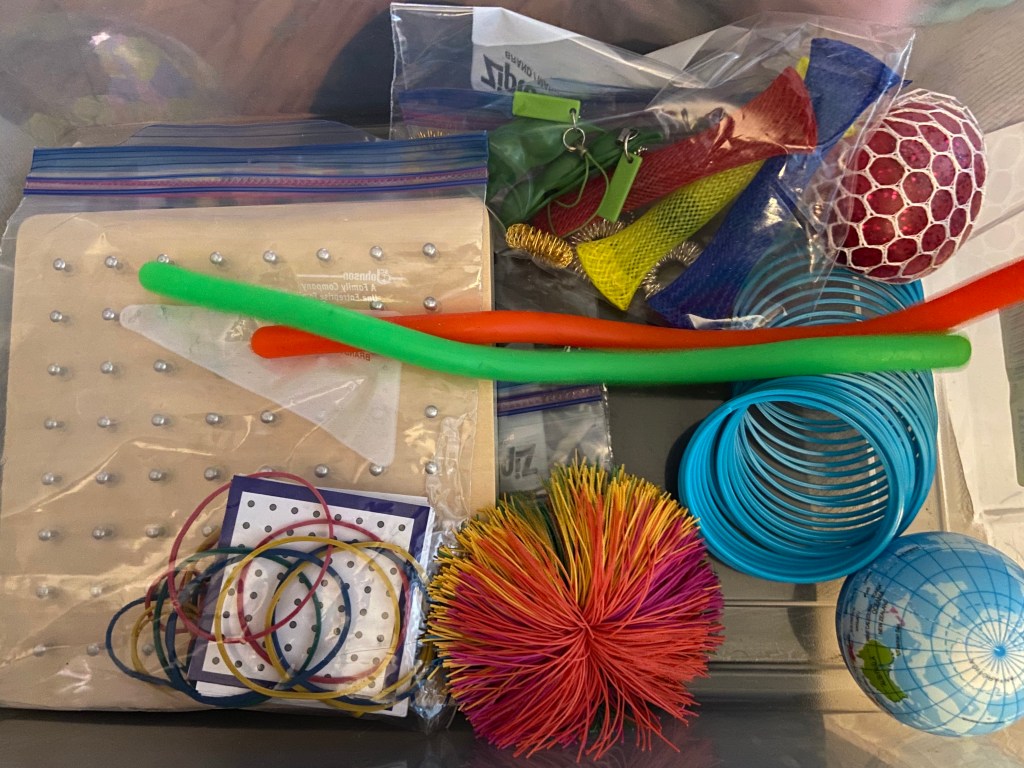
We were able to have two sessions with his new occupational therapist before everything shut down due to Covid. In the meantime, I came up with a Sensory Diet (pictured below), bought some fidget toys to assist with the sensory bin and luckily it was spring which meant lots of opportunity for outside play.

Like everyone else, we had to adjust our daily life. Although we were looking forward to have ‘J’ get started with occupational therapy to focus on his challenges, we did the best we could without it.

Overloads and Reactions

Every child with SPD is going to handle a sensory overload differently. This makes sense since the causes can vary, why wouldn’t the outcome?

For ‘J,’ there are so many things that can affect how he reacts to a situation where he’s uncomfortable. Sometimes it’s making a loud noise, other times it’s an actual scream. He could break down crying, get fidgety, act out or sometimes just give me a look where I can see he just needs some reassurance.

Most of the time we can be proactive in situations and deter whatever may affect him. At the very least, we always try to prep him from what he may see, hear or experience in any situation. If you’ve read this blog before, you know he’s huge on routine, so having a heads up to something new is always helpful.

Of course with a scream, people around us (family, friends, strangers) will notice. Being fidgety, acting out or giving us a look can be trickier. We know that he’s uncomfortable and we’re trying to get a handle on it or make it ok while those around us are clueless.

As I’ve talked about before, because SPD isn’t something you can see, people don’t always think through their actions because to them, ‘J’ often appears carefree. Someone we know might invite us to a big party, which is great and usually ends up being fine but we also know that ‘J’ will never be 100% comfortable. Others may play loud music, change up a routine, or try to play around by surprising him. His reaction can definitely run the gamut in these instances from giving a look to an all out meltdown.

When this isn’t a part of someone’s ever day life, it’s not a natural instinct to think through the moves you make. But taking an extra minute to think through actions can make all the difference to someone with sensory sensitivities.

Not Understanding Doesn’t Equal Not Existing

Sometimes when people don’t understand things, their automatic go-to is that it doesn’t exist.

When a person breaks their arm, you can see it. You know how it gets fixed and before long, the arm is back to new. With other conditions such as anxiety, depression or in my world, sensory processing difficulties, you can’t see it. There’s no cast to put on, and if someone hasn’t experienced it on some level, they’re not going to understand it. But, it doesn’t mean that it doesn’t exist.

I’ve talked about this a little in a past post, “Is This a Real Thing?” I’m sure I’ll talk about it again in the future because it’s an ongoing conversation. Being a part of various social media groups, I read so many stories of families not being supportive of a child with sensory processing difficulties. Often the parents will hear that they don’t discipline enough or that their child needs to learn respect. Sometimes a spouse doesn’t understand what’s going on, is scared of what others will think and therefore rejects the idea of an evaluation. When really, the sooner you get your child the proper therapy he/she needs, the quicker they will begin to thrive.

I don’t think everyone in our world fully understands what ‘J’ is going through or even what it all means. But they are supportive and only want the best for him. We’re still learning everyday. I’m lucky to have a spouse that is on the same page as I am and we work through it all as a team. I feel for those who don’t have the support since it’s stressful enough on it’s own.

There is plenty to catch up on from the couple of months I’ve been away from blogging and we will definitely get to it all!  A person won’t be cured sensory difficulties, but they can be given tools to help them through everyday instances that most of us take for granted. I hope those that are starting off without the support they need, eventually find it.


World OT Day

I couldn’t let today go by without acknowledging World Occupational Therapy (OT) Day.

I’m so thankful for J’s Occupational Therapist. She has taught us so much, made J feel comfortable during his sessions and is always available to answer our questions. Although a complex profession and not centered around one specific niche, Occupational Therapists work to promote independence for their clients. Whether they’re working with children or adults, they work to help them grow socially, physically and emotionally.

For us, it seems appropriate to celebrate OT during Sensory Processing Awareness Month. OT helps J navigate through daily activities easier while providing us with a better understanding on how we can help him succeed.

Auditory Sensitivities

Imagine sitting in your living room, watching TV and your 4 year old pops up and says “hey, what’s that?” But you don’t hear anything. He knows there is something and starts looking around until he gets to the window, lifts up the blinds and reveals a fly.

‘J’ has always been able to hear sounds from far away. As a baby playing on the floor, far in the distance there would be a horn honking and he would lift his head up. When we realized he had a speech delay, I was asked if I had concerns about his hearing. I said no.44034957_172598086940946_1868850213062443008_n.jpg

Fast forward to a few months after his sister is born, the three of us driving in a car and she is hysterical in the back. ‘J’ loses it and I think he’s being empathetic for his sister. He was and still is, but he’s also negatively affected by her crying. It’s a trigger for him. As you know from a previous post, “When is it Empathy and When is it Sensory,” this was one of my first red flags and what lead me to learning more about Sensory Processing Disorder.

Another great book I came across, since I follow them on Twitter (@sensorysmarts) is “Raising a Sensory Smart Child.” In the book, authors Lindsey Biel and Nancy Peske takes the reader through the various reactions to sound, how it connects to learning and the vestibular connection. I would definitely add this book to your library for anyone navigating through sensory difficulties.

I notice a change in ‘J’ when sounds are affecting him. They’re not always loud, they’re not always sudden but it can affect the way he feels or acts in a snap. Sensory Processing Difficulties are different for everyone. This is just one of the ways it affects ‘J.’

October is Sensory Processing Awareness Month

1 year ago, I didn’t know that October was Sensory Processing Awareness Month. We were just starting the process of researching which eventually lead to approval for Occupational Therapy.

This blog was inspired by the fact that ‘J’ has sensory processing difficulties. I will be working hard this month to help spread awareness by sharing our stories.

‘J’ works so hard in Speech Therapy, Occupational Therapy and school. I’m so proud at how far he’s come and love watching him grow.

Click here to read where our Sensory journey began.