What is Sensory Processing Disorder?

A question I get asked a lot! Not an easy one to answer since it’s different for everyone.

The STAR Institute for Sensory Processing Disorder is a great resource. Here is their umbrella definition:

“Sensory processing (originally called “sensory integration dysfunction” or SID) refers to the way the nervous system receives messages from the senses and turns them into appropriate motor and behavioral responses. Sensory Processing Disorder (SPD), exists when sensory signals are either not detected or don’t get organized into appropriate responses. Pioneering occupational therapist, educational psychologist, and neuroscientist A. Jean Ayres, PhD, likened SPD to a neurological “traffic jam” that prevents certain parts of the brain from receiving the information needed to interpret sensory information correctly. A person with SPD finds it difficult to process and act upon information received through the senses, which creates challenges in performing countless everyday tasks.”

They also mention that “symptoms of Sensory Processing Disorder, like those of most disorders, occur within a broad spectrum of severity.”

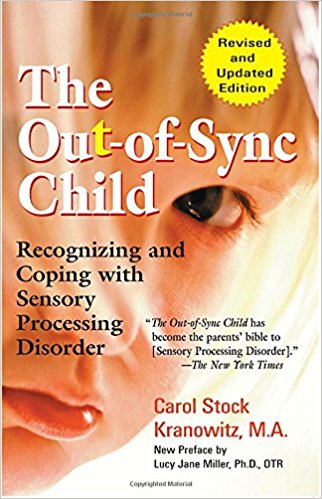
That last line goes back to what I mentioned in the beginning. Due to that broad spectrum, this can be different for everyone. It’s helpful that I started reading “The Out-Of-Sync Child.” There are many sub-categories of Sensory Processing Disorder that the book gets into. Within those sub-categories there are descriptions as to how a child may react if they are considered overresponsive, underresponsive or sensory-craving. Children can fit into one of these boxes or maybe a variety within the subcategories  As I continue to read “The Out-of-Sync Child,” I’ll be sure to share what I learn and how my personal experience relates to that information.

I can’t even fully explain what exactly it is for ‘J.’ I can say he seems to relate to that of a sensory-craving child but there are definitely moments where he is overresponsive. I’m understanding more about him as I read and learn. I know what triggers him and what doesn’t. I’m also still surprised by what does and doesn’t trigger him. I don’t think I’ll ever stop learning or have a full grasp on it, but it will become more clear one as time goes on. I look forward to having more tools to help him through his sensory meltdowns so they don’t ruin a portion of or sometimes his whole day. I look forward to being able to better help him handle situations that give him anxiety. None of us like experiencing the unexpected. It’s scary, unnerving and stressful. For ‘J’ it’s that times a thousand. We do a lot of prep during the day. We discuss what we’re going to do, who we’re going to see and as any changes arise, we talk those through as well. Once we work with our Occupational Therapist and do the homework I’m certain we’ll have, I know he will be able to organize his thoughts and feelings so much better.

I mean he’s super smart…yeah I know every parent says that…but seriously…he’s insanely smart. Which could be an additional factor as to what’s going on. But that’s a blog for another time.

Links to a Few Resources

The Out-of-Sync Child by Carol Stock Kranowitz

STAR Institute

What Is Sensory Processing Disorder? A video posted by MichaelGrass House on YouTube

When Kids Don’t Act Like They’re Supposed To (Understanding Sensory Processing In Kids) A video posted by Your Kid’s Table on YouTube


When is it Empathy and When is it Sensory?

This is a question I asked our speech therapist in the Spring of 2017. My daughter was a few months old at the time and if we were in the car when she started to cry, my son, ‘J’ would cry and tell me to help her. When he first did this, I thought it was endearing and a little heartbreaking as well. Although I don’t doubt that those things actually exist, I started to realize it might be more than that. I questioned it more when we were with my niece and if she would cry, ‘J’ would request to “go home” or “go to his room” so he could calm down. I questioned it when we were out to eat with his friend after a playdate and his friend cried because he wanted a toy car. ‘J’ once again would start to cry and ask to leave. One night while laying with him as he fell asleep, I started googling (always an interesting activity) and realized this might be more than just empathy.

As time went on, I noticed how often he seemed overwhelmed in various situations. I also gave it some time to see if it was a phase he had to grow out of. It wasn’t.

He was Woody from Toy Story for Halloween and the back of the costume had velcro. This was the first time he ever seemed bothered by clothing. From then on, he asks for tags to be cut out of his clothes. We visited a drive -thru Christmas light experience, which we thought he would love! As soon as we arrived, he took one look at the large guitar playing lit up snowman and lost it. It was the saddest thing I’ve ever seen. I felt like I was watching him experience a real life nightmare.

51na3vVi9VL._SX320_BO1,204,203,200_

I started reading more into Sensory Processing and my gut said to seek out an evaluation. With the upcoming holidays and a Disney trip on the horizon, I wanted to make this happen sooner rather than later. Luckily I was able to get the evaluation done before the New Year and before our trip. I started to make notes for the evaluator regarding my concerns and when I was done I had over two pages. I was surprised, but once I thought back to things in the past I had brushed off and the recent months of new experiences we had, there were more than a few red flags.

This week we were approved for Occupational Therapy (OT) twice a week. I’m so happy and can’t wait to start! Seeing how much he’s grown and progressed with speech, I knowbeing in OT and doing exercises at home will help him better process his surroundings.

In recent weeks I’ve done even more research, joined Facebook SPD Parent groups and just started reading ‘The Out of Sync Child’ that I ordered on Amazon. Knowledge is power, right?

Click here to check out a video posted on YouTube explaining Sensory Processing Disorder. The video was posted by MichaelGrass House.