School May Not Look Like You Imagined: Part 3

Taking the School Bus

Back in my day, there were walkers and bussers. Walkers were the kids who lived too close to the school and didn’t qualify for bus services. Bussers, well that one is obvious. I was a walker.

When registering ‘J’ for school, we had to sign forms for him to take the bus and were told we would receive a bus pass prior to school starting. I asked if I was able to drive him myself or if he was required to take the bus. The woman was taken aback by the question and said of course I could take him but that every child had the ability to take the bus.

I knew ‘J’ would never go for it.

We did try though. We talked to him about it and asked if he wanted to try. It was a big no. At the time, his sister was 2 and stated “I’m gonna take the bus when I go to school!”

We figured we would start the school year with me bringing him, and maybe once he saw friends taking the bus, he would want to as well. One day he finally agreed to take it home from school. This was huge!

I received a message from his teacher saying that he started to cry once he realized it was time to line up and walk out to the bus. She let me know his friends consoled him and all chanted his name. This made my heart melt. Once they got outside, the Principal and Vice Principal were also cheering him on. He went onto the bus in tears.

My biggest fear was that he’d try to run. When faced with fight or flight, he typically choose flight. We had prepped him leading up to it; we would meet him at the bus stop and he should not to get off the bus until he saw us. But we were still a bit nervous.

My husband, J’s sister and I all went to the corner to wait for him. We were talking to a neighbor when we heard honking, we look over and the bus had pulled up right in front of the house. We ran over and he walked off the bus in a pile of tears and sniffles. He did it! He rode the bus! Something he was so nervous about but he made it through.

He made it clear he never wanted to do it again.

The only other time he has taken the bus since that day was for his only field trip. They went to see a stage show of Frosty the Snowman. He sat next to his teacher and did great. I think being with his whole class, having the comfort of his teacher there and knowing I was picking him up once he returned to school helped to make that bus ride a whole lot easier.

Truth be told, having never taken a school bus myself (except for field trips), I was totally fine with the idea of picking him up and dropping him off. I just want him to always know the option is there for more independence. If he changes his mind one day and wants to ride the bus with his friends, we will support it. If not, that’s ok too.

In the final part of this series, I will discuss our experience with school closing due to Covid.

School May Not Look Like You Imagined: Part 2

Holiday Assemblies

I hate attention. I say this as someone who co-hosts two podcasts and does YouTube Lives. Guess you could say I’m a bit of an introvert/extrovert. When I was in school, I never liked public speaking, performing in a play, answering questions just in case I was wrong even when I knew I was right, etc. I was way too nervous. A little shy. Was there more to it than that? The early stages of my own anxiety? Probably.

I mentioned in the previous blog how much ‘J’ loved Kindergarten and that is 100% true. HOWever, once he started practicing for his Holiday Assembly, things started to shift. Especially when he went into the auditorium for rehearsals. The size of the stage, the bright lights, the echo, he was not feeling any of it. He didn’t want to sing the songs he had been singing all month long in and out of school. He didn’t want to be up on stage in front of everyone, he wanted nothing to do with it.

On the day of the performance, it was an extra hard drop off. His teacher was amazing and in the days leading up to it, she told him that he could stay with her until he was comfortable to go up on stage. Since this was December, 2019, we were able to go to the school to watch. There would also be a gingerbread house decorating activity after the performance for families.

The three of us walked into school to sign in for the show. I looked down the hall to ‘J’s” classroom, his teacher made eye contact with us and waived us down. I knew things weren’t good. We walked down to the end of the hallway to his classroom and saw him behind a desk, eating a graham cracker with puffy eyes. His friends were around him, checking in on him and telling him everything would be ok. He looked up to see us and ran right into my arms crying. All four of us went to the auditorium together and took our seats, right in front of the stage, behind his teacher.

His class walked in and took their spots on stage. We asked him if he wanted to go up with them and he said no. His teacher asked if he wanted to sit next to her and he said no. He stayed on my lap the whole time, watching his friends sing the songs he grew to love.

The thing about ‘J’ is, when he gets himself worked up to the point of not participating in something, he never feels like he’s missing out. He feels relieved, happy and content. He was happy to be watching his friends and cheered them on. Afterwards, we were all at one long table, building gingerbread houses together and all his anxiety was lifted. He returned to the happy boy he is, laughing with his friends.

Our heart breaks watching him struggle with new situations. His anxiety spikes, he wants to run away, he cries. As parents, we want the best for him and for him to be able to branch out and try new things. At the same time, he knows what he likes and what makes him comfortable. Sometimes he does need that nudge, like going into school. But other times, if something is overwhelming him to the point of tears, is it worth the push? We’ve seen the outcome of that and it’s typically not good.

Seeing your child on stage for the first time may be something you’ve thought about with excitement. And it may turn out exactly how you imagined. But there is that chance that it just may not go according to plan.

In Part 3, I’ll chat about taking the Bus.

School May Not Look Like You Imagined: Part 1

The First Day of School

During my blog hiatus, I thought about a lot of different posts I wanted to do and this was one of them.

‘J’ is coming up on finishing 1st grade.

<Excuse me while I go cry.>

When starting Kindergarten last year, ‘J’ was so nervous. While most kids were posing in front of the big “First Day of School” signs in front of the school, I was focused on just getting him out of the car and through the front doors. I asked if I could take a picture of him, but I already knew the answer – no. In the world of social media, I knew all these parents would have pictures of their kids with the signs, posting them everywhere, and showing off those “perfect” moments.

Did the fact that I wouldn’t be a part of that bother me? No. Because it doesn’t matter! Social Media is not real life. It shows real moments in the midst of life but at the end of the day it’s not what matters. I say this as someone that incorporates social media into her daily life, so I’m not judging others that do the same!

The thing that mattered most to me was making sure ‘J’ was ok and had the best 1st day possible. We arranged a walk through of the school the week prior. He got to meet his Vice Principal, see his classroom, check out the cafeteria, specials classrooms and got a feel of the school. We made a social story for him that we read in the days leading up to school. Anything that was going to help with this transition, we were all about. The Vice Principal and I had a chat about how he may need some help on the first day.

And he did. He was so nervous, even after seeing a friend. As soon as the doors open, he was crying and clinging to me. I made eye contact with the Vice Principal, she came right over, pulled him off of me and walked him into school. I turned around, held my breath and cried in my car.

The tears were a mix of things:

Relief – I did it! He’s at school, he’s going to love it, I just had to get him there. (Just as a note: my husband read him his social story and pep talked him along the way. But we decided for drop off, it would be best for just a 1:1 instead of all four of us.)

Mom Guilt – Oh my God, I just left my baby boy in a new school with strangers! Knowing this was silly and I’d laugh about it later, in the moment, it was hard letting go.

Nervous – Knowing he would be fine, but hoping I wasn’t going to get a call during the day that the tears hadn’t stopped.

As the year went on, some drop offs were better than others but none were perfect. He never walked into school excited. BUT he absolutely loved everything about school. His teacher, friends he made, what he was learning, his specials, all of it. He was so happy during the hours of 8:10 and 2:15. From 8:09-8:10, not so much.

If your child has sensory processing difficulties and anxiety or maybe they’re shy and want to approach school experiences differently, my best advice would be to follow their lead. Go with the flow. Don’t feel the pressure of other parents, your own family, social media or what someone may see as “normal.” If you get that perfect picture in front of their new school, great! If you got one at home (like we did), fantastic! If you get none, oh well! As long as they were happy, you got through the first day as a parent and they got through the first day as a kid, that’s all that matters.

In Part 2 I’ll chat about Holiday Assemblies.

Magical Mommy Monday Meets Sensory Spectacle

If you’ve checked out my previous blogs, then you saw a series written by Becky Lyddon, founder of Sensory Spectacle.

Fun fact: I host two podcasts! One is Theme Park Thursday with Dillo’s Diz, with my brother, where we focus on Disney nostalgia. The other is Magical Mommy Monday with my friend, Angela Dahlgren.

Ok, now that the cheap plugs are done, we can move on.

Becky was kind enough to take time out of quarantine to chat with us on the Magical Mommy Monday Podcast. Along with her amazing YouTube videos and her website containing trainings, she also has a podcast as well.

Click here to check out episode with Becky to learn more about her background, sensory processing and Sensory Spectacle!

You can visit Becky’s one stop shop for Sensory Spectacle here: https://www.sensoryspectacle.co.uk/

A Sensory Evaluation: Take 2

During his Kindergarten year, ‘J’ received Occupational Therapy at school. His Occupational Therapist (OT) was awesome and we stayed in contact to keep each other in the loop. However, occupational therapy in school typically focuses more on fine motor skills (ie: handwriting) and whether or not the student cannot focus in class. ‘J’ was doing great in both of these areas. Unfortunately, the school could not provide more assistance when it came to sensory difficulties. They did not have the space or types of therapies to assist students in this way. It was recommended that ‘J’ would not receive OT for 1st grade.

Knowing that ‘J’ struggled with lighting, sounds and still had separation anxiety during morning drop off, we had him evaluated by an outside OT. He was evaluated at the end of February, 2020 in the areas of Touch Processing, Visual, Oral, Movement and Motor. Without going into specific details, he received scores under the categories of “More Than Others” or “Much More Than Others.”

It was recommended that ‘J’ receive occupational therapy for help reduce sensory sensitivity in the area of auditory, touch processing, visual, oral and sensory seeking behaviors. There would be focus on strategies to help reduce anxiety in social settings, to make him become more comfortable with challenges and to adapt to given situations within his life.

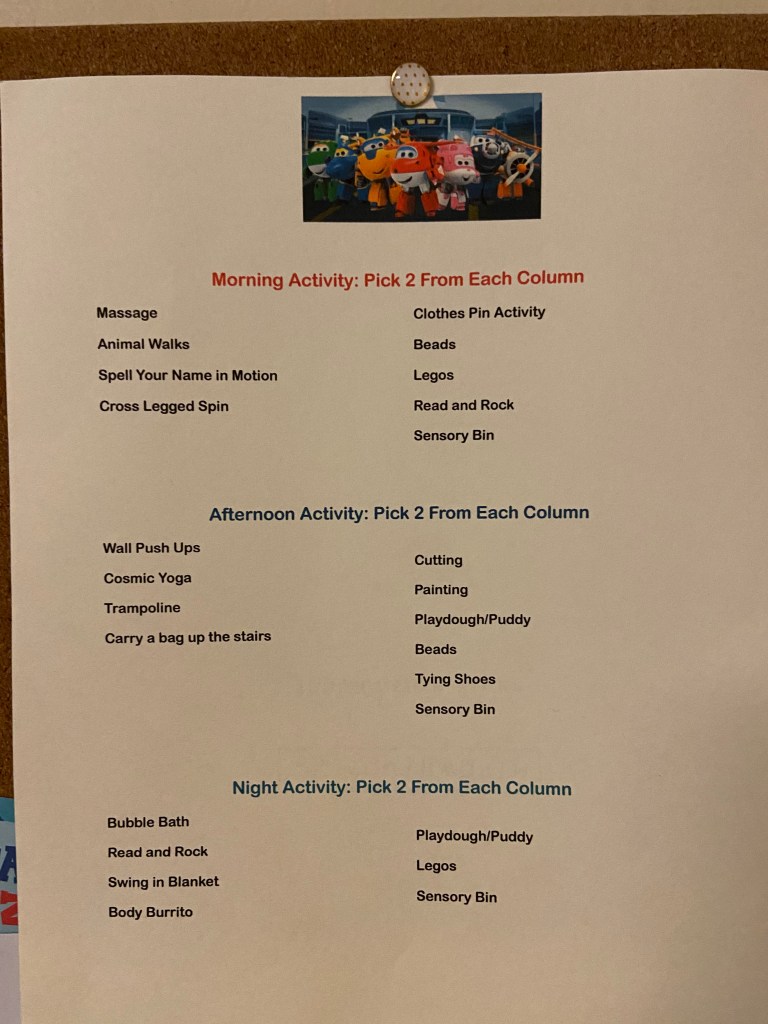
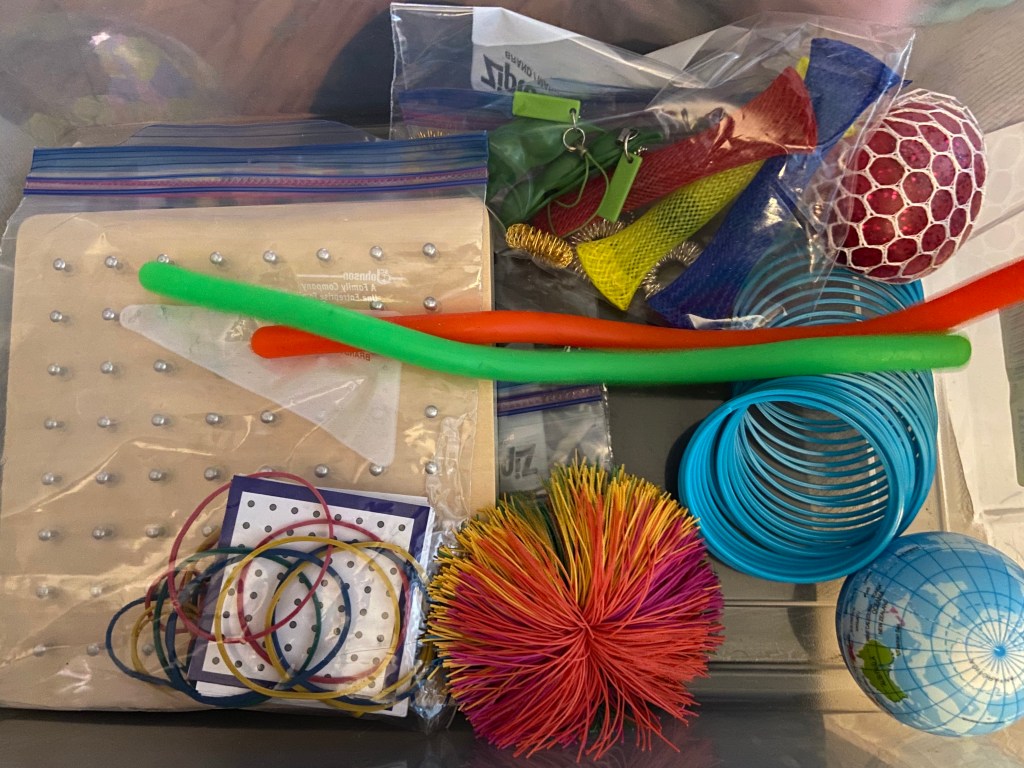
We were able to have two sessions with his new occupational therapist before everything shut down due to Covid. In the meantime, I came up with a Sensory Diet (pictured below), bought some fidget toys to assist with the sensory bin and luckily it was spring which meant lots of opportunity for outside play.

Like everyone else, we had to adjust our daily life. Although we were looking forward to have ‘J’ get started with occupational therapy to focus on his challenges, we did the best we could without it.

Overloads and Reactions

Every child with SPD is going to handle a sensory overload differently. This makes sense since the causes can vary, why wouldn’t the outcome?

For ‘J,’ there are so many things that can affect how he reacts to a situation where he’s uncomfortable. Sometimes it’s making a loud noise, other times it’s an actual scream. He could break down crying, get fidgety, act out or sometimes just give me a look where I can see he just needs some reassurance.

Most of the time we can be proactive in situations and deter whatever may affect him. At the very least, we always try to prep him from what he may see, hear or experience in any situation. If you’ve read this blog before, you know he’s huge on routine, so having a heads up to something new is always helpful.

Of course with a scream, people around us (family, friends, strangers) will notice. Being fidgety, acting out or giving us a look can be trickier. We know that he’s uncomfortable and we’re trying to get a handle on it or make it ok while those around us are clueless.

As I’ve talked about before, because SPD isn’t something you can see, people don’t always think through their actions because to them, ‘J’ often appears carefree. Someone we know might invite us to a big party, which is great and usually ends up being fine but we also know that ‘J’ will never be 100% comfortable. Others may play loud music, change up a routine, or try to play around by surprising him. His reaction can definitely run the gamut in these instances from giving a look to an all out meltdown.

When this isn’t a part of someone’s ever day life, it’s not a natural instinct to think through the moves you make. But taking an extra minute to think through actions can make all the difference to someone with sensory sensitivities.

Not Understanding Doesn’t Equal Not Existing

Sometimes when people don’t understand things, their automatic go-to is that it doesn’t exist.

When a person breaks their arm, you can see it. You know how it gets fixed and before long, the arm is back to new. With other conditions such as anxiety, depression or in my world, sensory processing difficulties, you can’t see it. There’s no cast to put on, and if someone hasn’t experienced it on some level, they’re not going to understand it. But, it doesn’t mean that it doesn’t exist.

I’ve talked about this a little in a past post, “Is This a Real Thing?” I’m sure I’ll talk about it again in the future because it’s an ongoing conversation. Being a part of various social media groups, I read so many stories of families not being supportive of a child with sensory processing difficulties. Often the parents will hear that they don’t discipline enough or that their child needs to learn respect. Sometimes a spouse doesn’t understand what’s going on, is scared of what others will think and therefore rejects the idea of an evaluation. When really, the sooner you get your child the proper therapy he/she needs, the quicker they will begin to thrive.

I don’t think everyone in our world fully understands what ‘J’ is going through or even what it all means. But they are supportive and only want the best for him. We’re still learning everyday. I’m lucky to have a spouse that is on the same page as I am and we work through it all as a team. I feel for those who don’t have the support since it’s stressful enough on it’s own.

There is plenty to catch up on from the couple of months I’ve been away from blogging and we will definitely get to it all!  A person won’t be cured sensory difficulties, but they can be given tools to help them through everyday instances that most of us take for granted. I hope those that are starting off without the support they need, eventually find it.


Auditory Sensitivities

Imagine sitting in your living room, watching TV and your 4 year old pops up and says “hey, what’s that?” But you don’t hear anything. He knows there is something and starts looking around until he gets to the window, lifts up the blinds and reveals a fly.

‘J’ has always been able to hear sounds from far away. As a baby playing on the floor, far in the distance there would be a horn honking and he would lift his head up. When we realized he had a speech delay, I was asked if I had concerns about his hearing. I said no.44034957_172598086940946_1868850213062443008_n.jpg

Fast forward to a few months after his sister is born, the three of us driving in a car and she is hysterical in the back. ‘J’ loses it and I think he’s being empathetic for his sister. He was and still is, but he’s also negatively affected by her crying. It’s a trigger for him. As you know from a previous post, “When is it Empathy and When is it Sensory,” this was one of my first red flags and what lead me to learning more about Sensory Processing Disorder.

Another great book I came across, since I follow them on Twitter (@sensorysmarts) is “Raising a Sensory Smart Child.” In the book, authors Lindsey Biel and Nancy Peske takes the reader through the various reactions to sound, how it connects to learning and the vestibular connection. I would definitely add this book to your library for anyone navigating through sensory difficulties.

I notice a change in ‘J’ when sounds are affecting him. They’re not always loud, they’re not always sudden but it can affect the way he feels or acts in a snap. Sensory Processing Difficulties are different for everyone. This is just one of the ways it affects ‘J.’

Change of Weather

I have horrible allergies and sinus issues. These get worse when the seasons are changing or if there’s rain. I’m also not myself if it’s a rainy day. I think many others are like that too, right? How many times do you hear ‘it’s a perfect day to stay in and watch movies.’ Knowing all of this, I shouldn’t be surprised that I notice a change in ‘J’ on non-sunny days.

IMG_3938.jpg

When trying to pinpoint when I noticed the shift, I think it was last year during a windy day. He was having more meltdowns, seemed tired and overall was not himself. I couldn’t quite figure out what was going on until the next windy day when it happened again. Over time, I picked on cues from him on cloudy days, rainy days, a major shift in temperature, etc.

For those with sensory processing difficulties, a change in weather also means a change of clothing. Many people don’t enjoy socks on their feet or sweaters. They may feel overwhelmed in a jacket or get overheated easily with too many layers. We have these experiences on a smaller level, as ‘J’ is not a fan of tags in his clothing.

Sometimes what may not be a big deal for us or something we’ve gotten used to, will be a much bigger deal for someone with sensory processing difficulties. I hope all those that experience more difficulties during weather changes, have a smooth transition as we go from Fall to Winter!

One more thing: I should also mention that almost everyday, when we open the front door to leave the house ‘J’ will say “wow! it’s a beautiful day outside!” even if it’s not. Sometimes he can be a glass half full kind of kid.


October is Sensory Processing Awareness Month

1 year ago, I didn’t know that October was Sensory Processing Awareness Month. We were just starting the process of researching which eventually lead to approval for Occupational Therapy.

This blog was inspired by the fact that ‘J’ has sensory processing difficulties. I will be working hard this month to help spread awareness by sharing our stories.

‘J’ works so hard in Speech Therapy, Occupational Therapy and school. I’m so proud at how far he’s come and love watching him grow.

Click here to read where our Sensory journey began.