
How Does Sensory Processing Affect Sleep?

Taken from The Out-Of-Sync Child:

Falling asleep, staying asleep and waking up may be problematic The child with SPD may need an unusually long afternoon nap, or she may never nap even if exhausted. Because a sleep disorder is often caused be a separation problem, she may want to sleep with her parents She may have trouble comforting herself to sleep, or may constantly awaken during the night.

Sleep problems may be associated with high need for movement. If the child has not had her quota of movement during the day, her arousal levels may fluctuate erratically, and she may become overaroused at night. Over- or underresponsitivity also may cause the child to feel uncomfortable in bed. The pajamas or sheets may feel scratchy. The pillowcase may not smell right, especially after its familiar, ripe scent has been washed out. The blankets may be too heavy or not heavy enough.

My son is 9 and we still struggle with locking in a good bedtime routine. We have a routine, sometimes it works and sometimes it doesn’t. Both of my kids used to go to sleep at 5:00….yup 5! And some nights, I’ll still do that. When I put them to bed at 5, they fall right to sleep and will wake up at 6AM or after. Of course as they’ve gotten older, incorporating school and after school activities, 5:00 it a lot tougher. More often their bedtime is closer to 7. However, at this time, my 6 year old is typically overtired and my 9 year old will come out of the room a dozen times before settling. They’ll still wake up at 6AM or after.

They both wake up during the night, but my 9 year old tends to do it more. We try our best to make sure he’s had enough movement during the day and enough stimulation, without getting overstimulated. It’s an ongoing balancing act.

There are plenty of things you can try if you’re in a similar boat as us.

  • Warm baths
  • Plenty of Movement during the day
  • Limiting screen time closer to bedtime
  • Making sure they’re full from all their meals

However, as much as you try, you may also just be in it right along with us. If you are, know that you’re not alone!

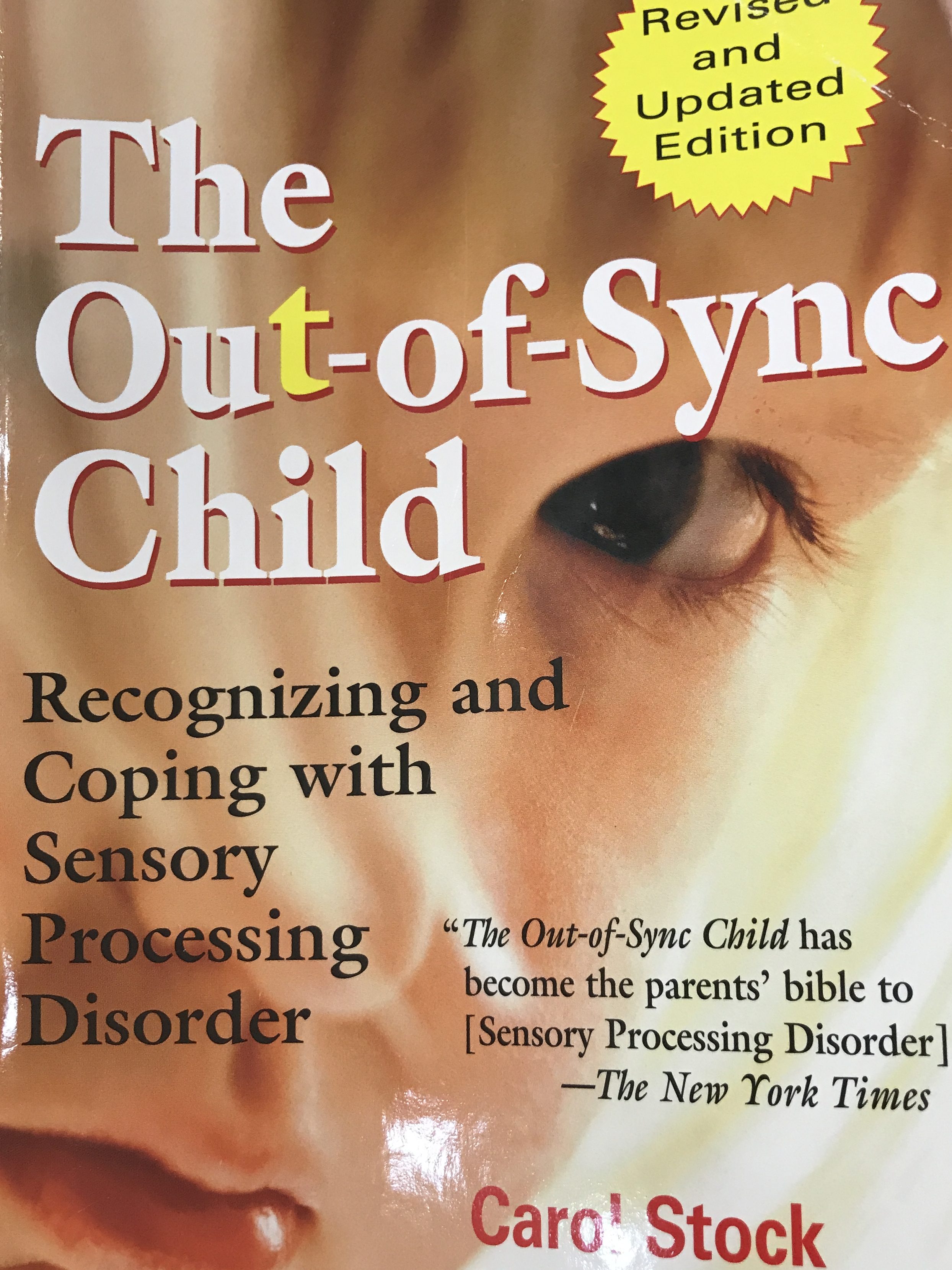
I recommend reading The Out-Of-Sync Child as a resource for all things sensory processing. The book has been updated since I originally purchased it and I am linking the most recent version.

Click here to check out The Out-Of-Sync Child.

Just My MomSense is a participant in the Amazon Services LLC Associates Program
Self Regulation

Taken from: The Out-Of-Sync Child:

The child may have difficulty modulating (adjusting) his mood. He may be unable to “rev up,” or to calm down once aroused. He may become fussy easily. He may have difficulty with self-comforting after being hurt or upset Delaying gratification and tolerating transitions from one activity to another may be hard. The child may perform unevenly: “with it” one day, “out of it” the next.

Self regulation can be extremely difficult for someone with sensory processing difficulties. As a parent, I have also learned how important it is for us to stay regulated when a child is feeling dysregulated. There are a variety of things you can do to help your child during this time:

  • Demonstrate deep breathing
  • Offer a safe environment if they are unable to control their bodies
  • Strong hugs/being covered in a weighted blanket
  • Try different parts of your sensory diet: swinging, jumping on a trampoline, playing with playdoh, etc.

You know your child best and what gets them back to a place of feeling comfortable. I recommend reading The Out-Of-Sync Child as a resource for all things sensory processing. The book has been updated since I originally purchased it and I am linking the most recent version.

I would also recommend listening to the Living a Sensory Life Podcast, where Becky Lyddon discusses self regulation and sensory characteristics.

Click here to check out The Out-Of-Sync Child.

Just My MomSense is a participant in the Amazon Services LLC Associates Program

SPD in Teens and Adults

I often get asked if ‘J’ will grow out of his sensory processing difficulties. This is not something kids grow out of since it is a part of them. However, the work he is doing now and will continue to do will hopefully give him the tools to help him better handle his daily routine in the future.

The STAR Institute for Sensory Processing Disorder (SPD) posted a great article: “How SPD Affects the Out-Of-Sync Adolescent’s Emotions” by Carol Kranowitz, author of The Out-of-Sync Child. Click here to read the article.

Are you wondering what Sensory Processing Disorder may look like in adults? Click here to read all about it on additudemag.com. Thanks to social media, I noticed this article by the STAR Institute’s tweet!

Although kids and adults are affected by SPD differently, gaining insight is always helpful. Knowledge is power.

Be sure to check out the STAR Institute’s website  for more information about Sensory Processing Disorder.

STAR-Institute-logo

It’s Too Loud!

A big trigger for ‘J’ are sounds. He absolutely hates when our dog (or my parents’ dog) does her alert bark. If someone rings the doorbell, of course our dog is going to respond and let us know. Although she feels like she is protecting us, ‘J’ sees it as something that is being done to him.

One of my first red flags was seeing ‘J’ react to his sister or cousin crying. At first I thought he was just being empathetic (and I’m sure there is an aspect of that) but over time I felt like there was more behind it. It’s so hard to watch him react to their crying, especially if we’re in a car or somewhere else where he can’t remove himself from the situation. It completely overwhelms him and he cries and screams to express the hurt it’s causing him.

I think because he has started to realize that things that are too loud are overwhelming, he describes certain situations as “too loud” or “too big.” At this point we are try to work with him to understand what can soothe him in these situations. Sometimes it’s playing a Super Why game on our phones and other times it’s having a snack. Unfortunately sometimes we just have to wait it out, which is the hardest one of all.

In The Out-Of-Sync Child, Carol Stock Kranowitz discusses determining if a child has an issue with each sense. For the auditory sense, she details overrresponsitivity, underresponsitivty and sensory craving. Although I can relate ‘J’ to a few different aspects, one line stuck out for me: “If he can’t get away from the hubbub, he may raise his own voice, hollering, La-La-La-La! to counteract noise, rather like fighting fire with fire.” If ‘J’ doesn’t respond by crying to a sound that is bothering him, he starts screaming or talking louder to try to deal with the overwhelming sound.

Although these are my experiences, Sensory Spectacle has a video on their YouTube page that explains why some people may cry at sudden noises:


Mood Swings

Everyone has mood swings. Personally, if I don’t get enough sleep at night, I’m dragging during the day. I may not have as much patience, not get as much done or may just be out of it. If I haven’t eaten in awhile, I may be cranky or lightheaded. Some days things seem off and you’re just having a day.

Kids are affected in the same ways!

Now add in sensory difficulties. It’s the end of a day, you’re tired and hungry as you sit at a restaurant for dinner. Anyone may feel a bit edgy. But for someone with sensory issues, this restaurant may feel so overwhelming. If someone already feels like sounds are too loud, this may be even worse in this setting.

Although specific instances like being tired or hungry do not cause sensory issues, they definitely aid in triggering them. I know I see it for ‘J.’ I’ve seen changes in weather affect him. I’m sure that sounds weird, but it’s true. Other times its tougher to pinpoint if there is an external factor like hunger or the weather amplifying his triggers.

This post is just me thinking out loud. I am going to check out The Out-of-Sync Child and other resources to read more about external factors. If any readers can relate or would like to share their experiences-please do!


Is This a Real Thing?

I’ve mentioned before that one of the reasons I started this was because of the other blogs and articles I had read that helped me. Maybe my story might help another parent going through a similar experience!

Facebook groups have also helped. A community of parents asking questions, telling stories and sharing their experiences. There was a discussion one day as to how others react to learning about Sensory Processing. One person shared that her husband initially hadn’t even wanted their child evaluated. Others talked about their parents telling them that they just don’t discipline well enough. The kids get away with too much. Have too much. Some other family members and even doctors just didn’t believe it was a real thing.

Yet those parents that trusted their gut, got their kids the extra help they needed, had a much better quality of life. They were able to predict and most times prevent triggers. They now know what can calm their child. What their mind and body need to properly process information and self regulate in those disorganized situations. That mommy (or daddy) gut will never steer you wrong.

In ‘The Out-of-Sync Child,’  it states that research regarding Sensory Processing has been going on since the 50’s, even though most of us never heard about it. Much of the cause seems to be genetic, but there is still more research being done. I know when I was younger you never heard about this, but you also never heard much about food allergies. With the internet and especially social media, I think there an inundation of information regarding varying issues.

Again, because a child is “out-of-sync” doesn’t mean there is something wrong. It just means they need a little extra help going through the motions of daily activities.

Click here to read my blog What Is Sensory Processing, which includes even more reference links.

And don’t forget parents: Trust Your Gut!

It’s the Final Countdown

What a week it’s been!

Baby J’s sickness developed into a virus with a new symptom everyday! A few trips to the doctor and a week later, she’s finally feeling better!

Big J had a snow day from school on Tuesday and was back in the grind on Thursday. I’m so happy he loves going to school…I’m sure one day he won’t!

It’s the Final Countdown to OT! We start on Monday! With everything going on lately, Itenor haven’t even had time to think about it too much. I definitely want to write down some questions and get him ready for the addition to his routine. Due to the timing availability of OT, we have to rearrange our Speech Therapy schedule. With J so comfortable with his awesome speech therapist, it’s easy to make adjustments without it affecting him.

I need to catch up on my reading of The Out-of-Sync Child and gear up for Monday! I’ll be sure to keep you all in the loop with our new journey!

What is Sensory Processing Disorder?

A question I get asked a lot! Not an easy one to answer since it’s different for everyone.

The STAR Institute for Sensory Processing Disorder is a great resource. Here is their umbrella definition:

“Sensory processing (originally called “sensory integration dysfunction” or SID) refers to the way the nervous system receives messages from the senses and turns them into appropriate motor and behavioral responses. Sensory Processing Disorder (SPD), exists when sensory signals are either not detected or don’t get organized into appropriate responses. Pioneering occupational therapist, educational psychologist, and neuroscientist A. Jean Ayres, PhD, likened SPD to a neurological “traffic jam” that prevents certain parts of the brain from receiving the information needed to interpret sensory information correctly. A person with SPD finds it difficult to process and act upon information received through the senses, which creates challenges in performing countless everyday tasks.”

They also mention that “symptoms of Sensory Processing Disorder, like those of most disorders, occur within a broad spectrum of severity.”

That last line goes back to what I mentioned in the beginning. Due to that broad spectrum, this can be different for everyone. It’s helpful that I started reading “The Out-Of-Sync Child.” There are many sub-categories of Sensory Processing Disorder that the book gets into. Within those sub-categories there are descriptions as to how a child may react if they are considered overresponsive, underresponsive or sensory-craving. Children can fit into one of these boxes or maybe a variety within the subcategories  As I continue to read “The Out-of-Sync Child,” I’ll be sure to share what I learn and how my personal experience relates to that information.

I can’t even fully explain what exactly it is for ‘J.’ I can say he seems to relate to that of a sensory-craving child but there are definitely moments where he is overresponsive. I’m understanding more about him as I read and learn. I know what triggers him and what doesn’t. I’m also still surprised by what does and doesn’t trigger him. I don’t think I’ll ever stop learning or have a full grasp on it, but it will become more clear one as time goes on. I look forward to having more tools to help him through his sensory meltdowns so they don’t ruin a portion of or sometimes his whole day. I look forward to being able to better help him handle situations that give him anxiety. None of us like experiencing the unexpected. It’s scary, unnerving and stressful. For ‘J’ it’s that times a thousand. We do a lot of prep during the day. We discuss what we’re going to do, who we’re going to see and as any changes arise, we talk those through as well. Once we work with our Occupational Therapist and do the homework I’m certain we’ll have, I know he will be able to organize his thoughts and feelings so much better.

I mean he’s super smart…yeah I know every parent says that…but seriously…he’s insanely smart. Which could be an additional factor as to what’s going on. But that’s a blog for another time.

Links to a Few Resources

The Out-of-Sync Child by Carol Stock Kranowitz

STAR Institute

What Is Sensory Processing Disorder? A video posted by MichaelGrass House on YouTube

When Kids Don’t Act Like They’re Supposed To (Understanding Sensory Processing In Kids) A video posted by Your Kid’s Table on YouTube