Hitting the Reset Button

It’s so easy to get caught up in the craziness of day to day life. I feel like most have returned to making plans, seeing friends and family and being generally “busy.” As adults, we often find ourselves having to hit the reset button. Sometimes we realize we need to get more sleep, eat healthier, exercise more or set new goals. As parents, it’s important to know when we need a parenting reset or our kids need their own reset.

Sensory Processing difficulties can play tricks on you as a parent. You may think you’ve found your groove or have a good routine going. Maybe your kids have grown more and they’re able to express their feelings in a better way. You may even find they’re having more good days than difficult. But kids are little people that are evolving, changing and constantly trying to figure out the world. When we’re in a routine with school, activities and playdates, it’s easy to put that fact on the back burner. We’re just doing instead of making conscious efforts.

‘J’ is seven and a half and in second grade. He’s doing awesome in school. He loves his friends and teacher (and doing extra homework). He was fully virtual last year but did great adjusting back to in person learning. Being around new kids and seeing how they interact was a bit tough at first. He witnessed some rougher play, hitting each other, yelling in each other’s faces, all of which is not his personality. It definitely made him uncomfortable but he’s good about knowing right from wrong and over time started to understand varying personalities.

We’re in NY and this winter has been tough. Not too many days where we could be outside and play. This has an effect on him every year. As soon as the weather gets nicer, we’re outside daily and it definitely helps him regulate his body. With the colder temps, snow and rain, it’s not so easy. His mood is affected, his body is affected and eventually a light bulb goes off in my mind that it’s time to hit the reset button.

With ‘J’ getting older, how his SPD affects him has changed as well. He can spot if there’s a tag in his clothing that he wants cut out before he even wears it which is an improvement from a few years ago. If he’s frustrated or not getting his way, he can’t process how his body reacts to that emotion. Some adults aren’t good at dealing with their frustrations and he’s human, of course he’s allowed to be frustrated sometimes.

However, for him, he takes it out on himself. There’s negative self talk, he physically takes out his frustration on himself and as parents, it’s hard to watch. Especially when, prior to 6 months ago, he never did that.

The best thing we can do in these moments is to stay calm and keep ourselves regulated. No problem when your kid is hurting himself right? It’s not always going to be perfect but it has to be the goal or else the problem will just escalate.

For us, hitting the reset button meant taking a step back to make sure he doesn’t do anything dangerous while also not automatically reacting to everything he’s doing. It meant reminding ourselves that we need to stay calm in order for him to get back to that place too.

Bedtime was starting to get to be a struggle and I finally asked ‘J’ what was overwhelming him. He basically said he didn’t like being told what to do with the routine. So we said no problem, here’s everything we do before bed, how about you decide what you want to do first. This has been a game changer. The routine takes a little longer at night but we’re not in a battle anymore and that’s a huge win.

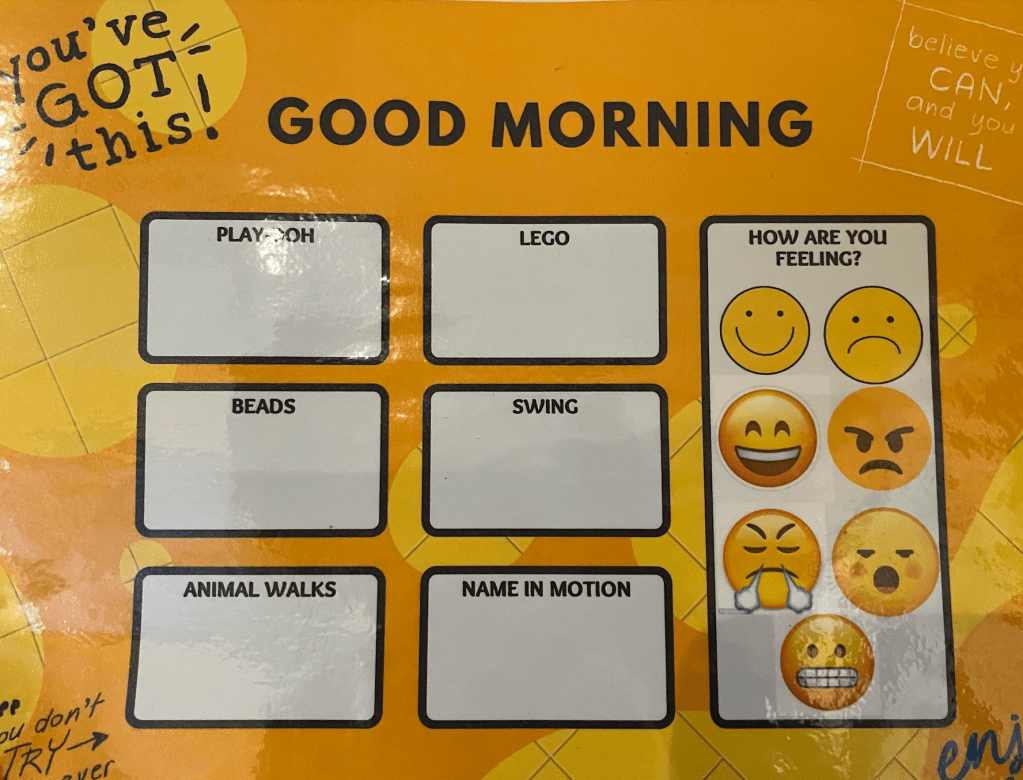
We also started incorporating sensory activities into our day again. This is one of those things that we can let slip when we’re so caught up in the day to day routine. Were we doing sensory activities some days? Yes. But not enough with conscious efforts behind it. We’re now having both kids choose what they want to do in the morning and in the afternoon on a chart. We have play-doh, beads, exercises, sensory swing time, reading a book in a rocking chair and others on the list. Some days we’ve brought their bicycles inside, put the training wheels in our shoes and let them pedal away to release some energy. They love this activity! They’ve used their imaginations to say where they’re going, what kind of adventures they’re encountering and who they may see along the way.

Going back to basics and remembering how important a sensory diet is (in whatever way you can fit it into your day), has helped mitigate some of those frustrating times. Of course they still happen and we will continue to work on different ways to get through those moments. Nothing will change overnight. It’s all about us as adults and our kids continuing to evolve, understanding emotions and figuring out ways to handle them.

Disney’s Disability Access Service Card

Back in 2018, I wrote about visiting Disney World with Sensory Processing difficulties. If you’d like to check out that blog, click here.

We just recently returned from a trip to Walt Disney World. As mentioned in that June 2018 blog, I knew that the Disability Access Service Card existed. For this trip, we decided we would play out how ‘J’ would do in the parks, knowing that this was an option.

Looking back, I’m wishing we did it from Day 1.

The first two days of our trip, we tried to wait on lines that were not too long, take our time moving around the park and getting in breaks during the afternoon. However, even on lines that we didn’t feel were too long (15-20 minutes), ‘J’ felt otherwise. He was extremely overwhelmed waiting on line, in a crowd and felt it would take much longer than we were telling him.

If you’re a parent with a child that does not have sensory processing difficulties, you may be thinking: ‘ok but no kid wants to wait on a line in Orlando summer heat.’ And you’re right! And I don’t like it either. But for ‘J’ it’s different and his reactions to it are different. Just like any other day to day activities that may appear easy for us, they’re not always easy for him. This goes under that same umbrella.

So what is the Disability Access Service (DAS) Card? According to the Disney Parks Blog:

The DAS Card is designed to accommodate guests who aren’t able to wait in a conventional queue environment due to a disability (including non-apparent disabilities). DAS will be issued at Guest Relations main entrance locations and will offer guests a return time for attractions based on the current wait time. As soon as the Guest finishes one attraction, they can receive a return time for another. This service can be used in addition to Disney’s FASTPASS Service and Disney FastPass+ service.

On the third day of our trip, we headed to Hollywood Studios and went straight to Guest Relations. I explained that ‘J’ had sensory processing disorder and found the lines to be…and then the Cast Member finished my sentence with: overwhelming? She took us over to the side and set us up with a DAS from her handheld device. We were told that we would need to go to a specific attraction to get a return time and that the pass would be good for the entire trip. We wouldn’t need to go to guest relations each day to have it set up again.

This pass was a game changer! I could see a weight lifted off of ‘J’ as we went to different rides. He was calmer, less stressed and more excited. Isn’t that how it should be at Disney?

I’m so thankful to Disney for accommodating all of their guests and for their amazing service helping us to obtain our DAS.

If you’d like to learn more, visit the Disney Parks Blog or reach out to Disney Guest Relations!

School May Not Look Like You Imagined: Part 4

A Pandemic

In this series, I’ve talked a lot about J in Kindergarten. There was something else that happened that year which affected all of us: Covid.

In the days leading up to March 13th, we started hearing about some local schools closing as Covid cases were rising. We wondered if our school would follow along and second guessed even sending him in the meantime.

On Friday, March 13th, I picked J up from school. He was sent home with a packet of work and some login information for various websites as a “just in case.” At 5:00, we received a call that the school district would be closing for the following week. On Monday, the announcement came that they wouldn’t return until the end of March. As we all now know, in person learning was done for the year.

I’m thankful J had the teacher he did and that we are a part of an amazing school district. There were calls, emails and constant communication. Teachers sent out materials, websites, calendars with suggested activities and learning to get everyone through this time. In April, the staff got together and did a neighborhood parade where they drove through the district, honking the horns of their decorated cars and putting smiles on everyone’s faces. J was so excited to see his teacher again. It brought tears to my eyes.

In May, the staff from the High School drove around placing “Class of 2020” signs in front of the homes of the seniors. We have neighbors that were a part of this and I completely lost it watching the parents and kids hugging as the signs were placed. This was such a crazy time for all kids and senior year is supposed to be the best year. The class of 2020 had it cut short and turned upside down.

We spent the summer wondering what school would look like once Fall came. What decisions would the school make? What decisions would we have to make?

Ultimately the school decided to offer two options. The first was a hybrid model. You could send your child in twice a week (3 days every other week) and on the days they were home, they would learn remotely. The second was a fully virtual model, which is what we chose.

J works best when he’s in a routine and knows what to expect each day. We felt the back and forth of the hybrid model, coming off of a year of tough drop offs, would have had a negative impact. Although learning virtually would be new and have an adjustment period, at least it was consistent.

Prior to the holidays, J’s school returned to a full in person model, for those that were interested. If we had sent J back, he would have had to start with a new teacher, in a new class. This was also around the time that cases were once again rising. We decided to keep him virtual. As the year went on, the option to send him back remained open. There were kids from his class that went back and kids that had been in person, that joined his virtual class. The constant uncertainty among parents was clear. Everyone had to make decisions that worked best for their family.

We’re now weeks away from the last day of 1st grade (I can’t believe it)! J did amazing with virtual learning, probably too well. I have no words for all that his teacher did for a large class of remote learners. He had a schedule of google meets throughout the day, independent work and extra work if he was up to it. He is always up for extra work. Since Kindergarten, he has always created his own “extra homework.” He’s reading almost two grade levels ahead of where he is and has learned so much this year. There was an adjustment period in the beginning of not wanting to see himself on the screen during his google meets, not wanting to talk in front of everyone, etc. That went away quickly and he now loves to participate.

No one could have predicted the craziness of the 2020/2021 school year. I’m so thankful to teachers everywhere that went above and beyond for an experience no one was prepared for. Parents – you all made it through! The days were long and sometimes stressful, but we did it!

J’s school is Kindergarten through 2nd grade. His first year was cut short and now he’ll be returning in September for one year before moving on to a new school. It makes me sad that he didn’t get the normalcy and the amount of time he could have in a school we love.

Sometimes it’s not about sensory processing or anxiety, sometimes school doesn’t look like you imagined because of circumstances outside the home. The same can be said for parenting. We need to remember to expect the unexpected, go with the flow, do the best we can and take things one day at a time.
From Grunts To Words: Our 1st Year With Speech Therapy

I wrote this back in September. Although a little outdated, it explains how this journey began.

September 2017

10 months ago our 2 year and 3 month old son grunted instead of talked. His birthday is in June and we knew at that point since he wasn’t talking, he either needed a little more time or we may need to have him evaluated. We decided to go through the summer, give him some time and see what September brought. 

Where It Started

At about 4 months old, he started sleeping with a Mickey stuffed animal and at 14 months he was saying “Mickey.” This was also the time he started walking so we thought he was right on track with developmental milestones. After a few months, we noticed new words were not being introduced. Sometimes he babbled mama and dada but never in context. Every once in awhile we thought we would hear a “hi” but it was a stretch. About a month before his 2nd birthday, we realized we hadn’t heard “Mickey” in awhile. We kept an ear out for awhile and realized he wasn’t saying it, whether prompted or not. This was our first red flag. Not only had no new words been introduced, but now the 1 word he did have was gone. He spoke in grunts, pointed to things he needed and wanted and we understood it all. He turned 2, we gave him the summer and by September nothing had changed. We were afraid of pushing him if he wasn’t ready but more afraid of holding him back from being the best he can be if he needed help. 

We started looking on our county’s website for the details regarding Early Intervention Services and getting him evaluated. We kept going back and forth as to whether or not we should move forward. Were we too worried? Maybe he just needs more time. Maybe we need to be doing more. Ultimately, we decided to move forward in the process, which we heard could take some time.

He was evaluated on his gross motor skills and his speech. The evaluator for his motor skills knew quickly he was right where he needed to be in that area. The evaluator for speech could tell he understood everything she said, but wouldn’t use words to communicate back. She had a toy that popped. She played with it over and over saying “pop” until he did.  After a few tries, he said it and we were amazed! A few weeks and many signed forms later, we began speech therapy twice a week for 45 minutes each. Luckily, the therapists we were working with also conducted a mommy and me class twice a week and we took the opportunity to attend those as well. All of this was covered by the county and we paid nothing for our son to begin his journey towards speech. 

Once he was approaching his 3rd birthday, about 7 months in, he had to be re-evaluated since the services would fall under the school district once he turned 3. There was a debate as to whether or not we would be able to continue because of how much he knew and understood. Luckily, they could see that he still needed work on sentence structure and pronunciation. We were approved to continue services twice a week for 30 minutes each until his 4th birthday. 

Where We Are

One year later from starting the process, we’re about 10 months into services and have a chatterbox that just started Nursery School. I’m not crying, you are…

Looking back at these 10 months, we think about all the little milestones. Saying “boo” for blue-amazing! Using words in context-wow! Putting 2 and 3 words together and now using sentences, asking questions and singing the Frozen and Moana soundtrack – verbally he’s a completely different child. 

To say I’m grateful for the service coordinators and speech therapists we’ve worked with, would be an understatement. They offered support and care for our son and our family that we could never begin to repay. The work they do, the patience they have and the guidance they offer is above and beyond any expectations I had. I’m happy we will continue to work with our same speech therapist. Our son is so excited when she’s coming over and to us she will always be family. 

My advice to other parents would be to trust your gut. If you feel there may be a physical or speech delay, have them evaluated. The evaluators will let you know if your child needs more time or if they could use some help. It’s worth it for them to have the best opportunity to grow!

Now that we’re in January I can say that he absolutely loves school! His teachers and friends are great and he’s learning so much. His speech continues to improve and I’m so excited by all the progress he’s made!