Why I Create and Share Resources for Kids and Families Who Feel Everything

If you’ve been here for a while, you know that Just My MomSense has always been about me wanting to share things I’ve learned as a way to hopefully help other parents. Over the years, through the research, the conversations, and the the trial and error of parenting kids who experience the world a little differently, I’ve learned some things that genuinely changed how I show up for my kids.

The Thing That Changed Everything For Us: Co-Regulation

Your child cannot regulate their emotions alone and that’s not because something is wrong with them, it’s because their brain literally isn’t built that way yet.

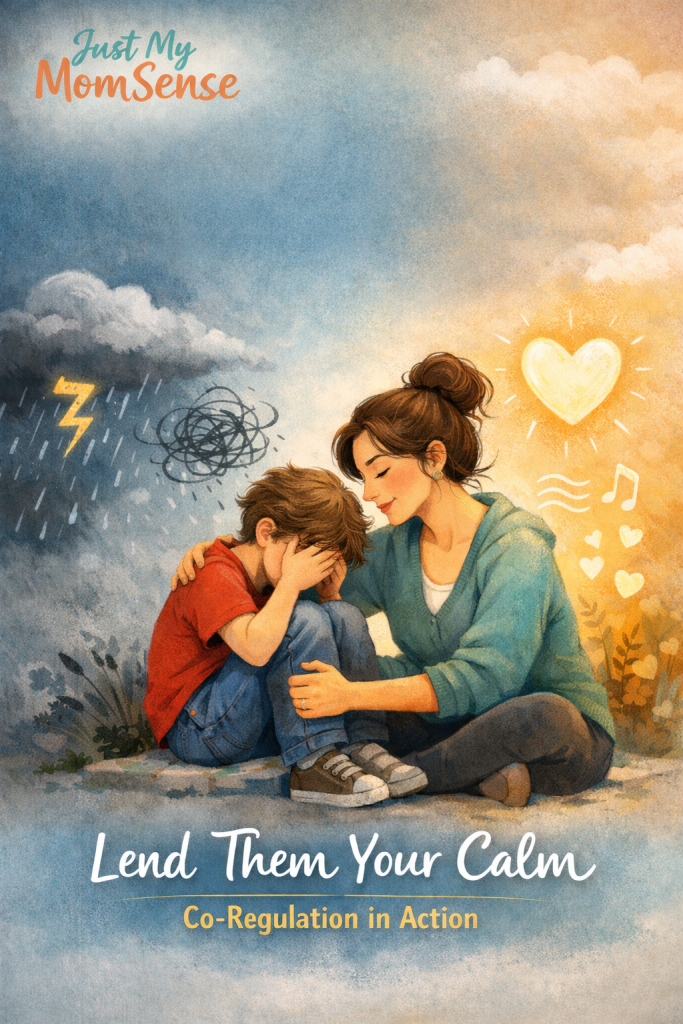
Co-regulation is the idea that kids regulate their nervous systems through connection with a calm adult. When you stay calm during a meltdown, when you lower your voice instead of raising it, when you sit nearby without demanding anything, you are literally lending your regulated nervous system to your child. For me, understanding this changed how I responded. Instead of trying to stop the meltdown, I started focusing on being the calm in it.

Please note that I know this is easier said than done when you’re in the middle of a spiral at 7am before school.

The Sooner They Can Name It, The Less It Controls Them

Another thing I’ve learned is that feelings that have a name are easier to manage than feelings that don’t.

When a child can say “I feel overwhelmed” instead of just melting down, something shifts in their brain. The thinking part comes back online. They feel understood instead of out of control. Over time, that emotional vocabulary becomes one of the most powerful tools they have.

This is why feelings check-ins matter so much, not as a worksheet exercise, but as a daily practice. When kids get used to checking in with how they feel, they start to recognize their own patterns. They notice when they’re getting close to the edge before they go over it. That awareness is so important. Kids who develop emotional literacy earlier tend to have better relationships, stronger self-advocacy skills, and fewer behavioral challenges as they get older. It’s not about being perfect, it’s just about building the language.

Things I Made

I started an Etsy shop awhile back without showing it much love. I wasn’t sure what I really wanted to put out there but I know I wanted it to be useful.

I wanted to take what I’ve learned about sensory processing, emotional regulation, meltdown support, routines and turn it into something practical. Something you could print out and actually use. Something that meets kids where they are and helps the adults who love them feel a little less lost.

Some of the items there include:

Calm Down Corner Kit: everything you need to set up a calm down corner that actually works, including a feelings check-in, breathing techniques, a calm down menu, and affirmation cards.

Meltdown vs. Tantrum Explainer Pack: because understanding the difference changes everything about how you respond. Includes a caregiver guide, trigger tracker, and recovery plan.

Sensory Overload Trigger Tracker: a sensory profile, trigger log, sensory diet planner, environment checklist, and calm plan all in one pack.

Visual Daily Schedule: routine charts, a school day planner, transition warning cards, a feelings check-in strip, and a reward chart. Great for kids who thrive on predictability.

Kids Sensory Journal: a way to help kids build mindfulness, gratitude, and emotional awareness.

Emotion Identification Cards, Brain Break Cards, and more!

Everything is an instant digital download. No branding on any of the pages. Print as many times as you need.

You can browse the full shop right here: Just My MomSense on Etsy

I Made A Freebie Too!

If you’re not sure where to start or just want to try something before you buy, I have a free printable for you.

The 5-Minute Feelings Check-In is a simple, kid-friendly tool you can use every single day to help your child build that emotional vocabulary we talked about. It takes five minutes. It’s free. And it’s a great first step toward helping your child understand what’s happening inside them before it comes out sideways.

Grab it here: Get the Free 5-Minute Feelings Check-In ← add your freebie link here

I want parents to know that what you’re doing matters. The fact that you’re reading this, looking for tools, trying to understand your child’s experience, that’s huge!

Some helpful links:

Just My MomSense on Etsy

Just My MomSense Podcast

Just My MomSense Previous Blogs

The 5-Minute Feelings Check-in That Can Change Your Morning

I’ve said it before and I’ll say it again, we talk a lot in our house about tools in the toolbox.

Anything that helps you reset when big feelings show up is a tool. Breathing, listening to music, building something with Legos, going for a walk, sitting quietly for two minutes. All of it counts. There’s no right or wrong tool.

Kids do so much better when they already know what their tools are before a hard moment hits. When everyone is calm is exactly the right time to figure it out together, not in the middle of a meltdown when nobody can think straight.

A feelings check-in is exactly what it sounds like: a simple, intentional pause to ask “how are you feeling right now?” before the day gets away from you. The simpler the better.

Kids, especially young ones, often don’t have the language for what they’re feeling. When you give kids a regular, low-pressure moment to check in with their emotions, a few things happen:

  • They build emotional vocabulary. The more often a child practices naming feelings, the easier it becomes in harder moments.
  • They feel seen. Being asked “how are you feeling?” and having someone actually listen to the answer, tells a child that their inner world matters.
  • You catch things early. A quick check-in can reveal that your child is anxious about a test, sad about something that happened yesterday, or just tired. Things you might not have known until the meltdown.
  • It works for parents too. Checking in with yourself alongside your child models exactly the behavior you’re trying to teach. Kids learn emotional regulation by watching adults do it.

If you want something tangible to anchor the habit, I made a free one-page Feelings Check-In printable you can print and stick on the fridge.

It includes a simple mood scale kids can point to, a space to write one thing on their mind, a grounding prompt, and a check-in section for parents too because you deserve to be asked how you’re feeling as well.

Grab your free Feelings Check-In printable here!

Print it once, use it every day. Some families laminate it and use a dry erase marker. Some print a fresh one each week. Whatever works for your house.

The mornings won’t always be perfect. But having a simple tool that opens the door to connection, even on the hard days, makes a difference. Not just for your kids, but for you too.

Routines That Actually Work: The 10-Minute Reset

If your house feels loud, if your kids feel dysregulated, if you feel one small request away from losing it…

This is your reminder: You don’t need a perfect schedule. You need a predictable anchor. Routines aren’t about rigidity. They’re about safety.

For kids (especially anxious, sensory-sensitive, or neurodivergent kids) routines reduce the invisible “what’s next?” stress that drains their nervous system all day long. When the rhythm of the day is predictable, their bodies can finally exhale.

And here’s the part no one talks about:

Routines regulate us too.

When you don’t have to reinvent the day every morning, your brain rests. You stop decision-fatiguing yourself by 9:12 a.m.

So instead of building an Instagram-worthy color-coded schedule, start here:

The 10-Minute Anchor Routine

Pick one transition that’s currently chaotic:

  • Mornings
  • After school
  • Bedtime

Then create a simple, repeatable 3-step rhythm.

For example (after school):

  1. Snack
  2. 10 minutes quiet decompression (audiobook, coloring, Lego, swing)
  3. Review the plan for the afternoon

That’s it. No charts. No bribes. No overhauls. Just predictability.

And when it falls apart (because it will)? You don’t scrap the system. You return to the rhythm.

Consistency beats intensity every time.

What Is Co-Regulation? How Borrowing Your Calm Helps Kids Handle Big Emotions

Let’s talk about co-regulation.

Before our kids can regulate themselves, they borrow our nervous systems.

When your child is melting down, spiraling, shutting down, yelling, crying, freezing, their brain is in survival mode. The logical, problem-solving part? Offline. Gone. On vacation.

What brings it back?

Not lectures. Not consequences (yet). Not “calm down.”

Connection.

Co-regulation is the process of helping your child return to a regulated state by staying regulated yourself or at least regulated enough.

And yes. That’s the hard part.

Because when your child is dysregulated, it’s dysregulating. Especially if you’re tired. Or overstimulated. Or carrying your own stress.

But here’s what co-regulation can look like in real life:

  • Lowering your voice instead of raising it
  • Sitting beside them instead of towering over them
  • Saying, “I’m right here,” instead of “Go to your room”
  • Taking one deep breath out loud so they can hear it
  • Offering pressure (a hug, a hand squeeze) if they’re open to it

You are not rewarding bad behavior. You are helping their nervous system feel safe enough to think again.

Once they’re regulated, then you can talk about what happened. Then you can problem-solve. Then you can teach.

Self-regulation grows from co-regulation.

And if no one co-regulated you as a kid? This can feel almost impossible. You might not have had someone model calm in chaos. That doesn’t mean you can’t learn it now.

Start small.

Next time things escalate, instead of asking, “How do I stop this?” try asking:

“How can I lend my calm?”

Sometimes that’s enough to shift everything. We’re not aiming for perfect. We’re aiming for safe. And safe builds skills.

When the Holidays Are Too Much: Navigating Anxiety & Sensory Overload as a Family

Although the holiday season can be magical, joyful, and full of tradition, it can feel loud, overwhelming, unpredictable, and exhausting. If this sounds familiar, you’re not alone.

On my latest Just My MomSense podcast episode, I talk more about why the holidays can be so overstimulating, how anxiety and sensory challenges feed into each other, and what we can do to help our kids (and ourselves) move through the season with more calm.

You can listen here or on your favorite podcasting platform!

Everyday Kindness: Small Acts That Make a Big Difference

Today is World Kindness Day, a reminder that kindness doesn’t have to be big, loud, or complicated. Sometimes, the most powerful acts of kindness are the quiet, everyday ones. As parents, we have this amazing opportunity to help our children understand that kindness is a skill, a habit, and a choice.

Here are a few simple ways families can celebrate kindness, not just today, but everyday:

Kindness begins in the little moments. Encourage siblings to help one another, say thank you, and use gentle words. Let your kids see you apologize when needed.

Create a “Kindness Jar.” Every time someone in the family does something kind, (holding the door, helping clean up, comforting a friend) write it down and drop it in the jar. At the end of the week, read them aloud and recognize the acts together.

Send a handwritten note to a teacher, draw a picture for a neighbor, or drop off snacks for your local library or fire station. Showing gratitude to others teaches kids that kindness connects us all.

Model it. When we give ourselves grace after a tough day or use positive words when talking about ourselves, we show our kids that kindness isn’t just something we give, it’s something we deserve, too.

Ask your kids what kindness means to them. You might be surprised by their answers. These conversations help build empathy and awareness.

Kindness doesn’t require perfection, it just needs intention. Today, take one extra moment to be kind, not only to others but yourself too. Then, share your favorite family kindness idea in the comments or tag #JustMyMomSense on social media! Let’s fill our feeds (and our homes) with a little more good.

Rising Together: How Mark Ingrassia Is Using Special Ed Rising To Empower Families and Educators

If you’ve ever felt overwhelmed navigating the world of special education, you’re not alone. This week on the Just My MomSense podcast, I talk with Mark Ingrassia, the heart and voice behind SpecialEdRising.com, to talk about his inspiring journey and mission to uplift families, educators, and students everywhere.

Mark is a passionate advocate and educator who has dedicated his career to supporting children with diverse learning needs. Through his podcast and website, Special Ed Rising, he’s built a safe and welcoming space for conversations about inclusion, advocacy, and understanding.

In our episode, Mark shares his journey into the world of special education, the lessons he’s learned along the way, and the inspiration behind Special Ed Rising. We also talk about the importance of community and how support, understanding, and a shared mission can make all the difference for children and the adults who champion them.

🔗 Listen to the Episode

For more about Mark’s work, visit SpecialEdRising.com and follow Special Ed Rising on social media.

ICYMI: Let’s Talk Executive Functioning with Dr. Val!

I was a bit under the weather last week, but wanted to make sure to let you all know about last week’s Just My MomSense podcast episode, before a new one drops tomorrow!

In Episode 13 of Just My MomSense, Dr. Val returns for a deeper dive into executive functioning skills. We talk about tools that help us plan, focus, organize and get things done. Whether you’re a parent, teacher, or just someone looking to strengthen everyday productivity, this conversation offers practical strategies and insight into how to support both children and adults.

Click here to listen to the latest episode with Dr. Val!

The Power of Community: Helping Children Learn, Grow and Thrive with Dr. Troy Roddy

On this episode of Just My MomSense, Jen talks with Dr. Troy Roddy. Dr. Troy is an educator, author, and fellow Disney Podcaster. They talk about building a community within a school, as well as with parents in order to help children develop a lifelong love of learning.  

Listen here:

Helpful Tools and Resources for Parents

Parenting doesn’t come with a manual, but I’ve found tools and resources that make the tough days a little smoother. Whether you’re navigating sensory processing challenges, school struggles, or just need a moment to breathe, these resources have been a lifesaver for our family.

Below, you’ll find links to other sites I’ve found helpful, as well as my Favorite Things page, podcast episodes, and items from my Etsy shop, all curated to bring practical support, calm, and comfort to your parenting journey.

Explore these resources to help you manage parenting stress, neurodivergent needs, and everyday challenges with confidence.

Sensory Spectacle YouTube Channel

STAR Institute

These are a few of my Favorite Things

Embracing Neurodiversity with Dr. Matt Zakreski | Just My MomSense Podcast

Understanding How We Learn with Dr. Val | Just My MomSense Podcast

Just My MomSense Etsy Page