Rising Together: How Mark Ingrassia Is Using Special Ed Rising To Empower Families and Educators

If you’ve ever felt overwhelmed navigating the world of special education, you’re not alone. This week on the Just My MomSense podcast, I talk with Mark Ingrassia, the heart and voice behind SpecialEdRising.com, to talk about his inspiring journey and mission to uplift families, educators, and students everywhere.

Mark is a passionate advocate and educator who has dedicated his career to supporting children with diverse learning needs. Through his podcast and website, Special Ed Rising, he’s built a safe and welcoming space for conversations about inclusion, advocacy, and understanding.

In our episode, Mark shares his journey into the world of special education, the lessons he’s learned along the way, and the inspiration behind Special Ed Rising. We also talk about the importance of community and how support, understanding, and a shared mission can make all the difference for children and the adults who champion them.

🔗 Listen to the Episode

For more about Mark’s work, visit SpecialEdRising.com and follow Special Ed Rising on social media.

The Power of Community: Helping Children Learn, Grow and Thrive with Dr. Troy Roddy

On this episode of Just My MomSense, Jen talks with Dr. Troy Roddy. Dr. Troy is an educator, author, and fellow Disney Podcaster. They talk about building a community within a school, as well as with parents in order to help children develop a lifelong love of learning.  

Listen here:

How to Explain Sensory Processing to Friends, Family and Teachers

One of the biggest challenges of parenting a child with sensory difficulties isn’t just managing the day-to-day, it’s helping the people around us understand what’s really going on.

Since October is Sensory Processing Awareness Month, it feels like the perfect time to talk about how we can explain sensory processing to the friends, family members, and teachers who love and support our kids.

Most people want to understand, but they don’t know how. Sensory processing can feel invisible from the outside. A meltdown over scratchy tags or a refusal to eat certain textures can be mistaken as “bad behavior” or “picky eating.” That’s where our voice matters.

Here are a few ways to explain it simply:

Use relatable examples.
“Have you ever been stuck in a room with a flickering light or heard nails on a chalkboard? Imagine if your brain felt like that several times a day. That’s what it can be like for my child.”

Keep it short and clear.
“Sensory processing is how the brain interprets information from the five senses. For some kids, it’s turned up too high, for others, it’s turned down too low.”

Share what helps.
“It’s not about fixing my child; it’s about supporting them. Things like headphones, weighted blankets, or breaks can make a huge difference.”

Lead with compassion.
Sensory needs aren’t “bad” or “wrong,” they’re just different.

The more we talk openly, the more the people around us begin to understand. And that understanding builds patience, inclusion, and empathy.

This Sensory Processing Awareness Month, I encourage you to share a piece of your child’s sensory story with someone new: a teacher, a grandparent, a friend. Every conversation plants a seed of awareness, and together, we can grow a more compassionate community for our kids.

One more note: Sensory Processing Difficulties aren’t kid-specific. It’s not something that goes away with age. There are ways to learn how to manage and support the day-to-day challenges and there are many adults that need support as well.

Do you have a way you’ve been able to explain sensory processing? Share it in the comments below or connect with me on Instagram!

    Tech Life Inner Circle Launch

    Did you know the Tech Life Inner Circle Membership, created by Joan Green, with over 35 years of expertise, offers a supportive community for those seeking to enhance their technological proficiency? Members gain access to live office hours, tech challenges, and webinars that focus on innovative strategies for improving organization, productivity, communication, and social engagement. Joan regularly invites experts in the fields of accessibility, aging, special needs, learning, and productivity to provide diverse perspectives and specialized knowledge. This membership offers tools and insights for effectively integrating technology into daily life, catering to both personal and professional growth. It’s an ideal resource for anyone looking to navigate the complexities of modern technology with expert guidance.

    This program is ideal for:

    • Parents: Gain tech skills that not only benefit you but also help you support your children’s educational and developmental needs.
    • Lifelong Learners: Stay connected and proficient in an increasingly digital world, reducing isolation and engaging actively with modern technology.
    • Educators and tutors: Improve your ability to incorporate technology into learning environments, making education more accessible and engaging for all students.
    • Executive Functioning Coaches: Enhance your toolkit with digital tools that support your clients’ needs for organization, planning, and task completion.
    • Speech-Language Pathologists, Occupational Therapists, and Educational Therapists: Build your confidence in integrating modern tech solutions to support individuals with ADHD, dyslexia, dysgraphia, executive dysfunction, attention, cognitive, communication, and other challenges.
    • Senior Care Providers: Equip yourself with knowledge and tools to improve the engagement and independence of older adults in your care.
    • Neuropsychologists,  Vocational Rehab Specialists, Disability/ Accessibility Support Specialists, and Educational Consultants: Discover cutting-edge technologies that can refine your recommendations, particularly for students  and adults with learning and cognitive difficulties.
    • Caregivers of Adults with Developmental Disabilities: Learn about assistive technologies that can help increase independence and self-sufficiency for those you care for.
    • Anyone Seeking Less Stress and More Engagement and Productivity: Explore how everyday tech can simplify tasks, manage time better, and enhance overall quality of life.
    • Professionals in Transition: Ideal for individuals shifting careers or entering new life stages who need to upskill quickly and efficiently in technology.

    Click here to learn more and to join the Tech Life Inner Circle with Joan Green!

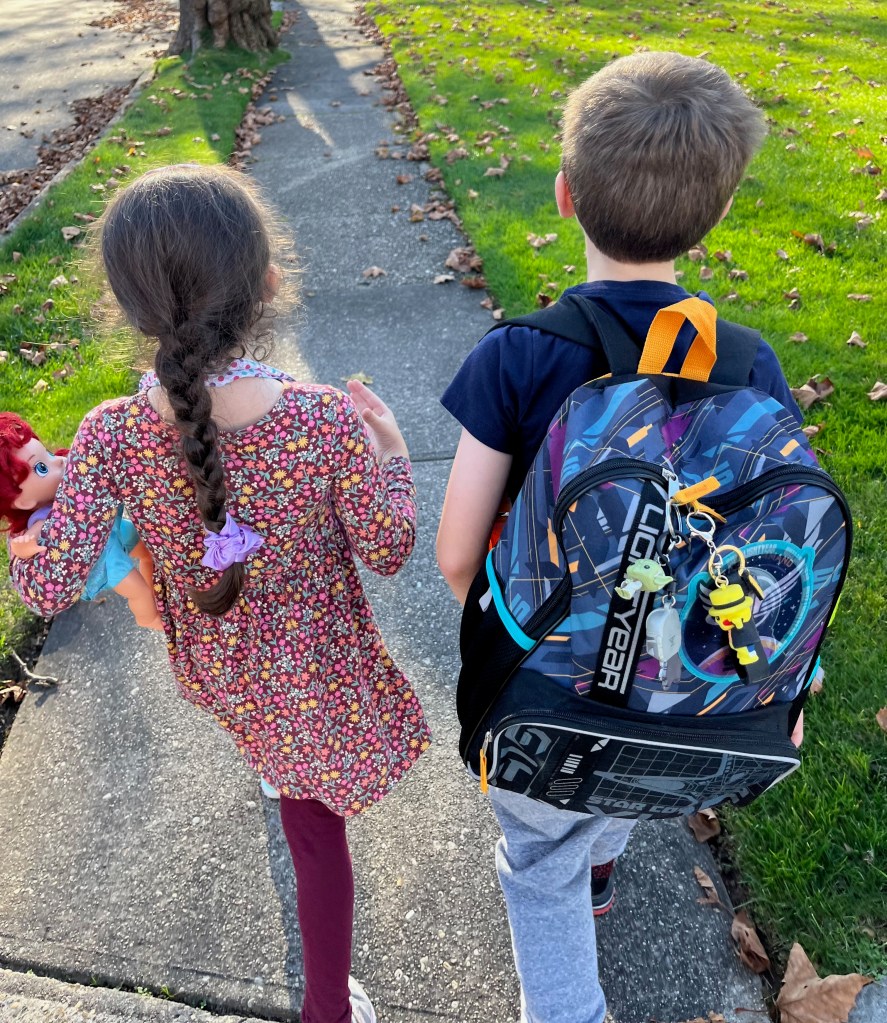
    The After School Eruption

    I remember reading awhile back that children often keep a cap on their emotions during a school day and by the time they get home, the cap pops off. They know they’re in a safe and caring environment. They’re in a familiar place. They can now just be themselves.

    My son is now 9, my daughter is 6 and the cap comes off each day. Some days it’s for a few minutes and some days (I’m looking at you Wednesdays) it lasts until bedtime. Being at school is a lot of work. When you’re experiencing different anxieties or having trouble grounding your senses, it can be completely overwhelming.

    In school, kids have to:

    • Sit in one spot for a good chunk of the day
    • Interact with different kids and adults
    • Be able to handle distractions going on around them, whether that’s another child calling out in the class or something happening outside
    • Visit the cafeteria with different smells, an increase in volume from everyone talking, different lighting, etc

    The list goes on. Now let’s throw in things like a child who is starting to get sick, maybe they have something going on at home, maybe they’re in the midst of a move or maybe they’re having a hard time making friends.

    Now your child walks through the door at the end of the day carrying a suitcase full of mental, emotional and social experiences. It’s no wonder it pops open!

    Consider this blog another reminder that kids are just small people trying to figure out life. Not so different from adults. Being a kid is hard and giving them the tools to help process all the ups and downs will help them as they get older and all of that stuff they’re carrying grows too.

    The after school eruption can be tough, remember to regulate your own emotions from your day in order to help them regulate their day.

    (Sometimes easier said than done but we’re all out here trying our best)

    Click here to check out some of my favorite books and products that can help with the after school eruption.

    Themed Learning Week | Day 2

    “Climb the mountain, not so the world can see you, but so you can see the world.” – David McCullough

    The World was our theme for Day 2 this week!

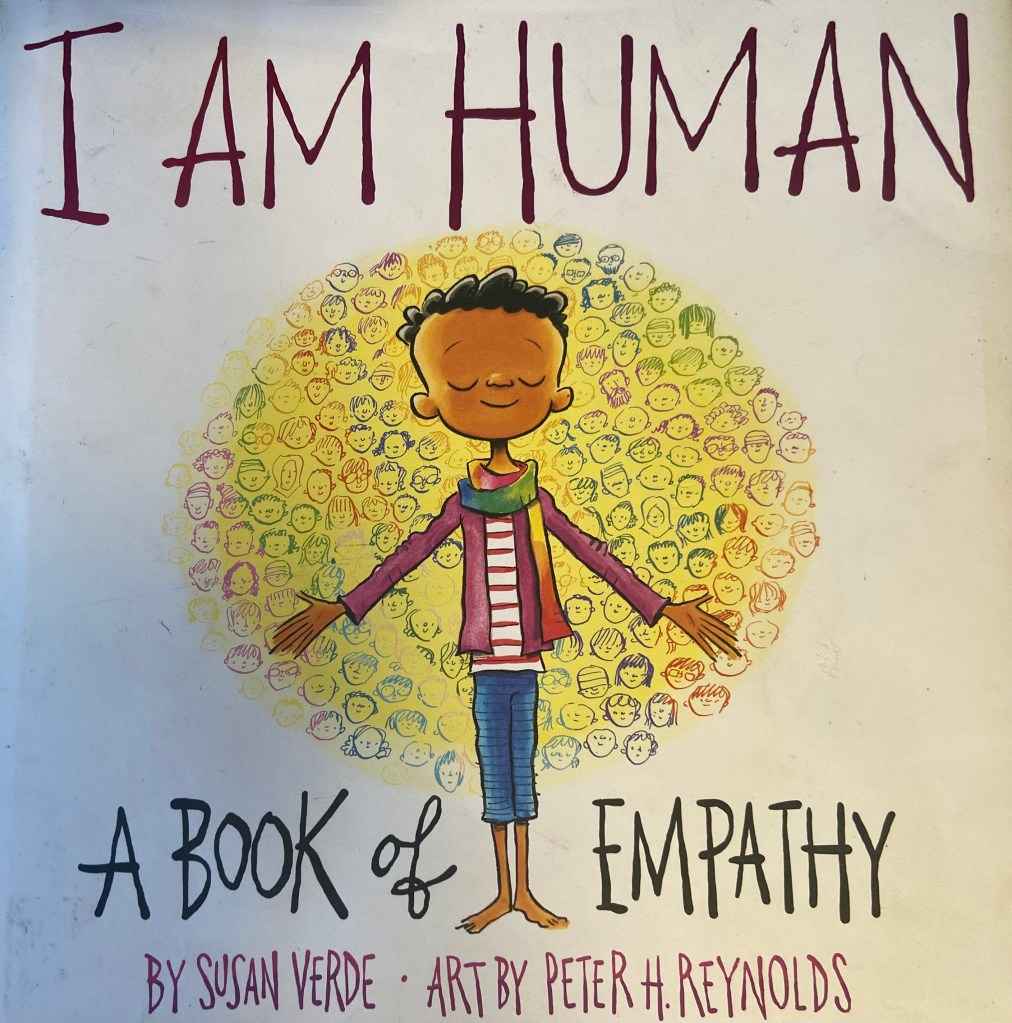
    We kicked off our time by reading an oldie but goodie “I Am Human.” We love adding this book into our rotation from time to time to open the discussion of kindness, how we’re all connected and what we can do to make the world a better place. The conversation led to why it’s good to reduce, reuse and recycle and different types of ways we can help other people.

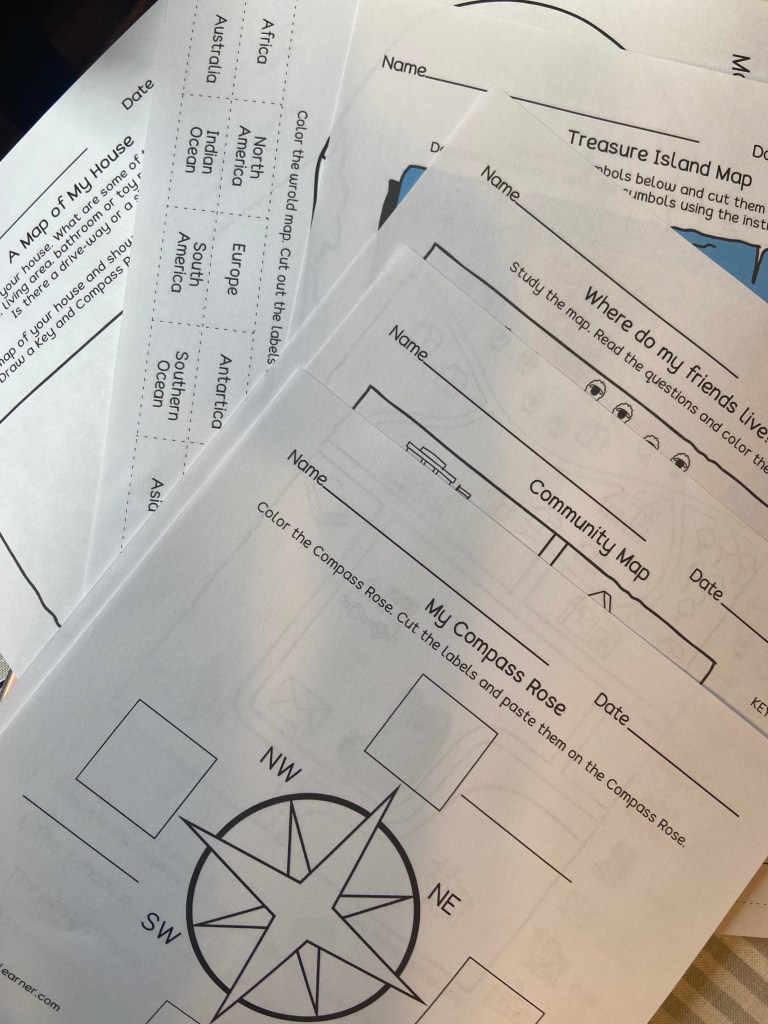
    I found these awesome worksheets from clevelearner.com via Pinterest. They got to review directions of a compass and started to working on reading a map. Would a map discussion be complete if they weren’t able to create their own treasure map?

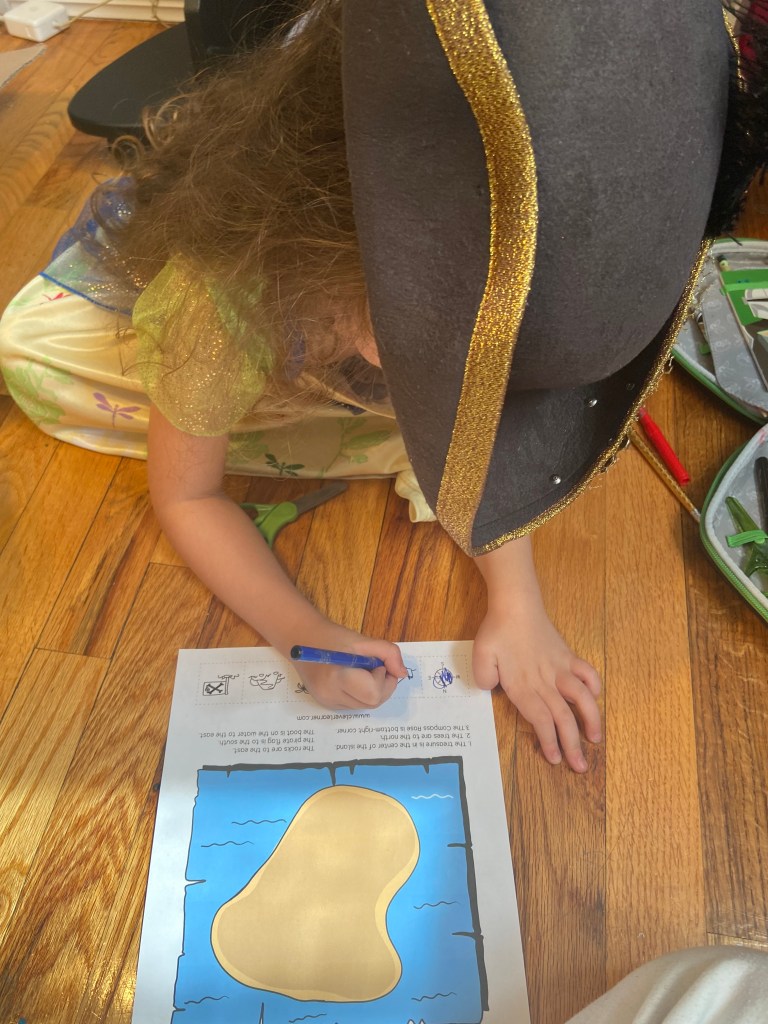
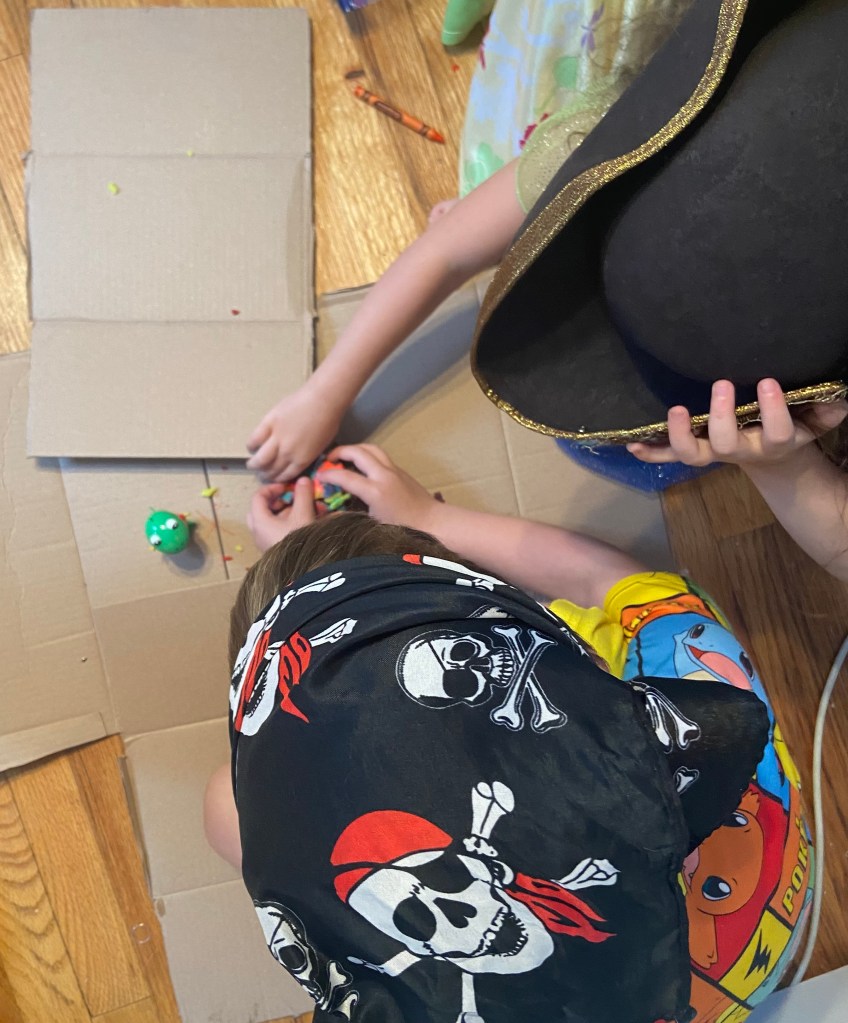
    They decided to complete the treasure map while dressed as pirates. I took apart an old box and planned to have them create a city out of it. They had bigger plans!

    Since they were already dressed as pirates and had a treasure map, why not create a whole island? They got to work with crayons, Play-Doh, figures and anything else they could find!

    All in all, Day 2 was a success. The best part was watching their imaginations take over and finish off learning time.

    There will be a total of 4 days in this series. A cold ran through the house that gave us a mid-week break!

    Themed Learning Week | Day 1

    In the last few weeks I’ve been squeezing in some learning time during the day. Not too much where they feel like it’s “school” but just enough to get some practice in before school starts. They’ve been doing some workbook pages, iPad learning games and having some solo reading time daily.

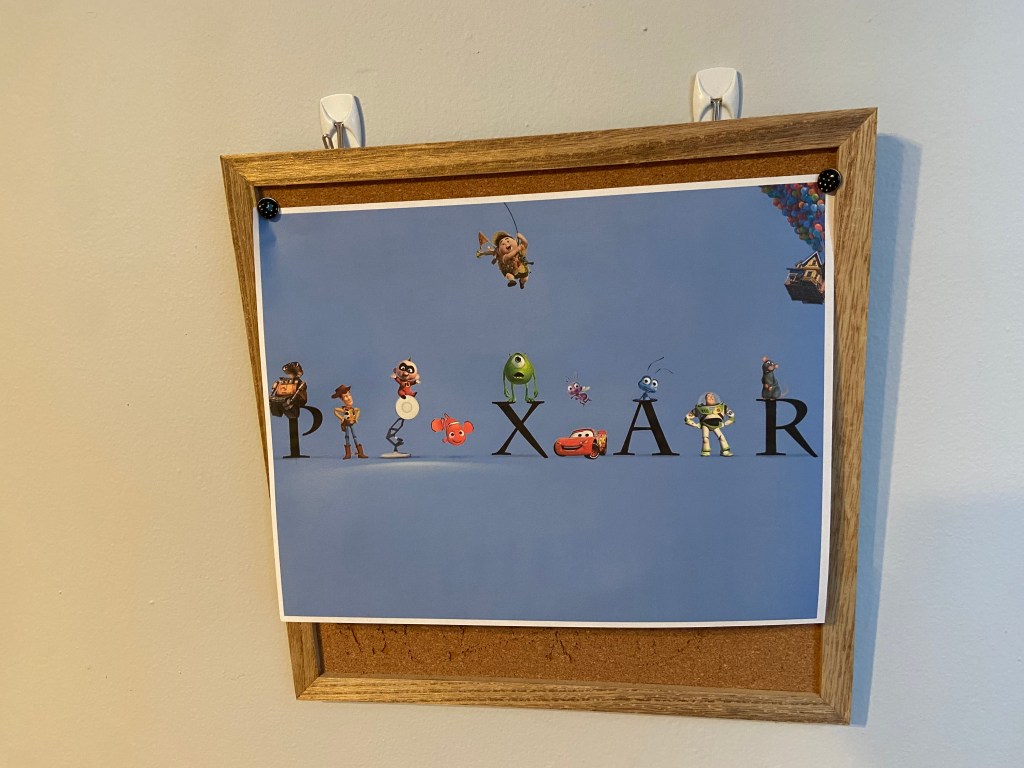
    This week I decided to change things up by having a theme each day for “Learning Time.” First up: Pixar Day!

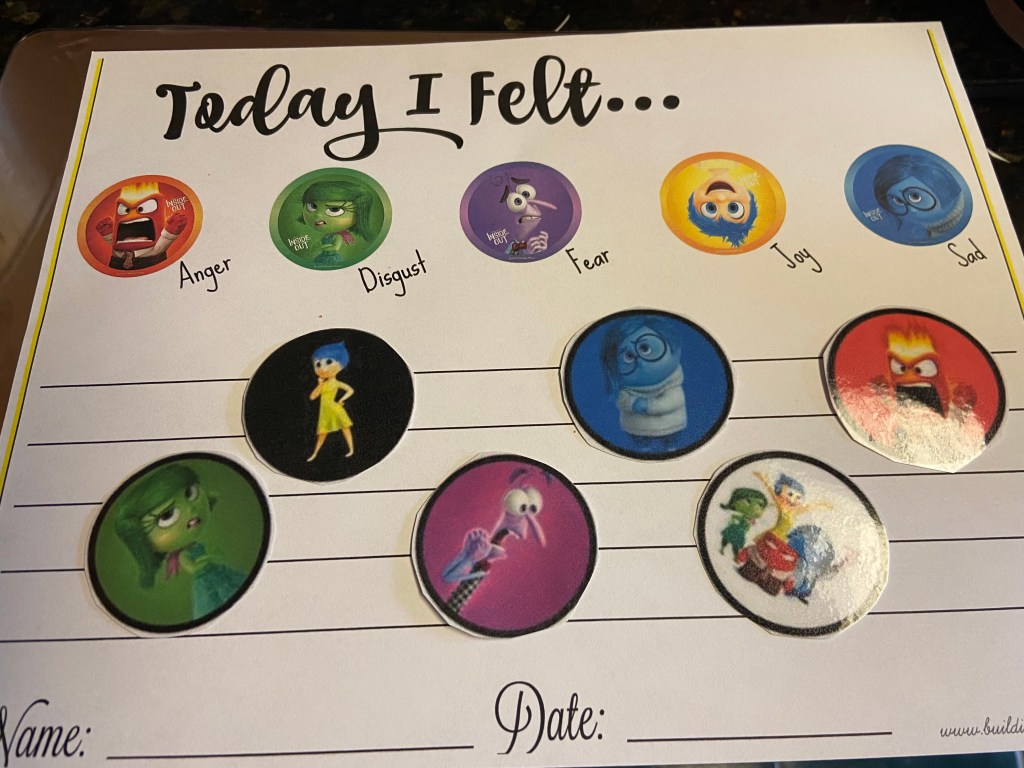
    Have I mentioned how thankful I am for Pinterest? They get me through any kind of spontaneous teaching/learning I end up doing! I found this ‘Inside Out’ worksheet (courtesy of buildingyourstory.com) and circles (which I laminated and cut out).

    I had them write out how the felt, in age appropriate ways. ‘J’ at 7 was able to write out sentences, while his sister at 4, copied which feeling she aligned with and one word that caused her to feel that way. They both picked Joy and considering it was Monday, I thought that was a great way to kick off their week!

    I created a game with the circles. I turned them all face down and had them take turns picking one. Whatever circle they picked, they had to describe a time they felt like that character.

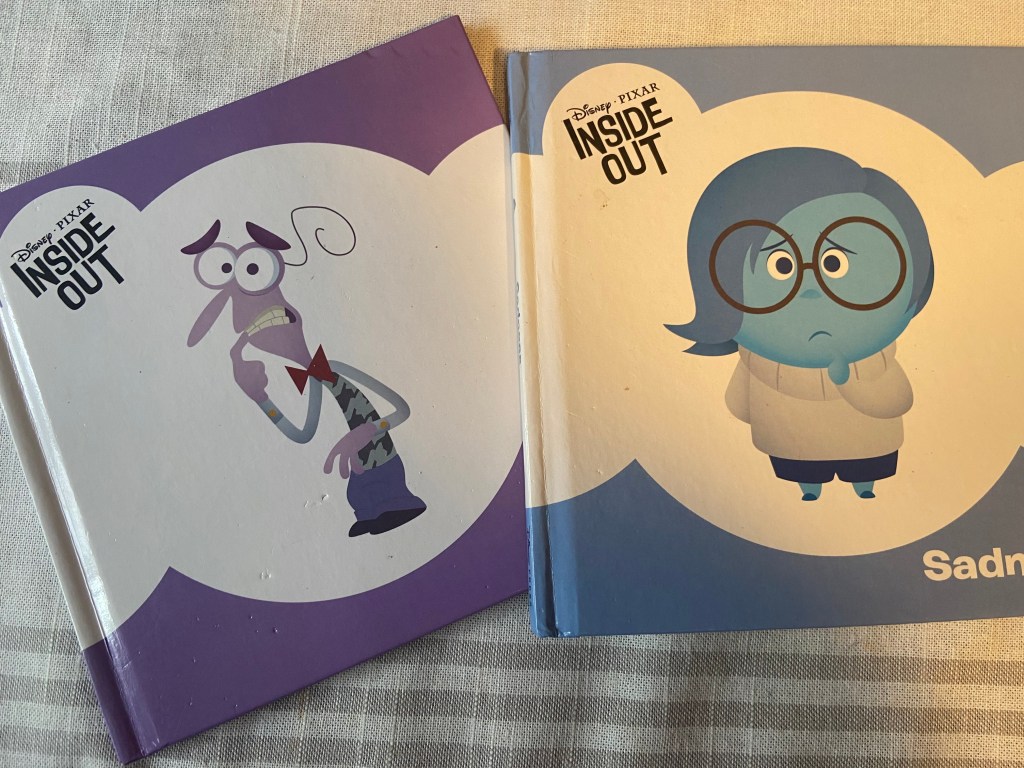
    Since we were on a social-emotional path, we also read some of our ‘Inside Out’ character books.

    Staying on our path, we discussed the Silenzio Bruno scene in ‘Luca.’ We talked through silencing negative thoughts, replacing them with positives and being brave! Then they colored this worksheet!

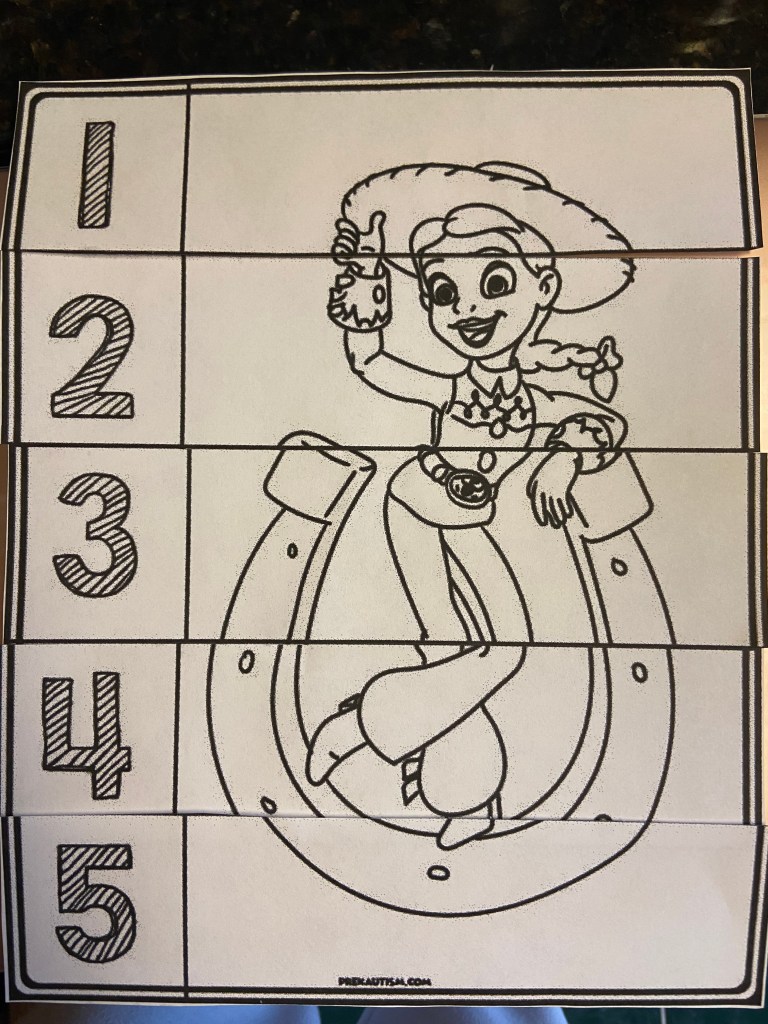
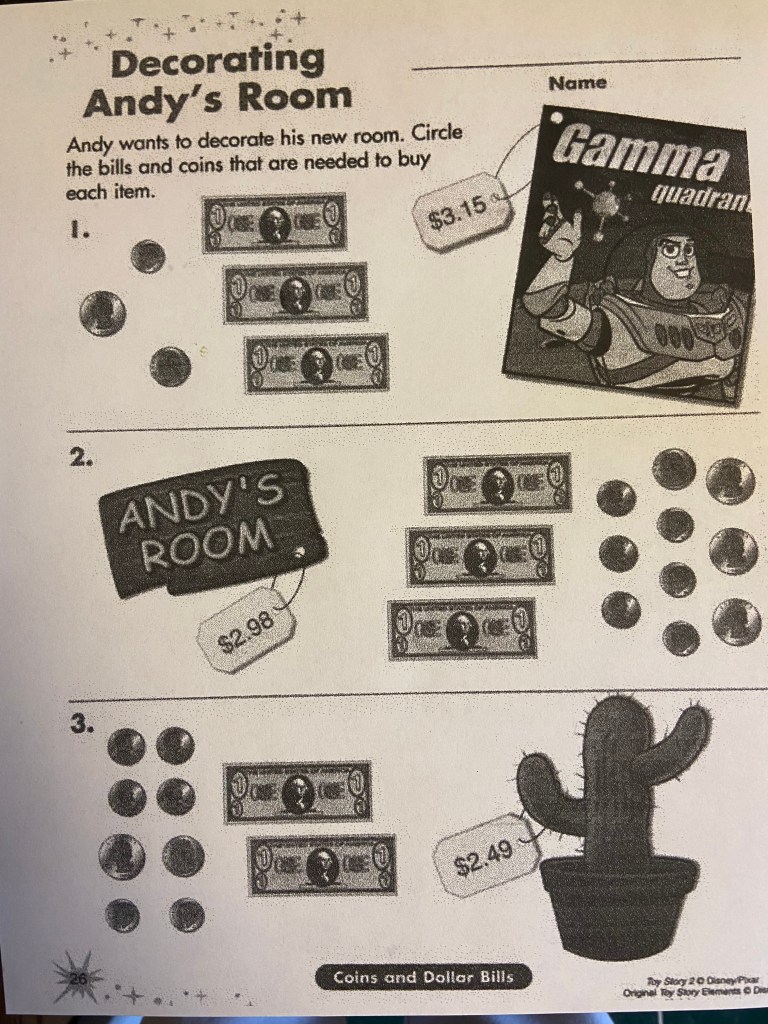
    Next up, I snuck in some age appropriate Math! ‘J’ practiced money with a Toy Story worksheet and his sister worked on a Toy Story puzzle to practice number order. I built on both a bit by changing up the number order for the puzzle and having ‘J’ use pretend money to pay for the items on the worksheet.

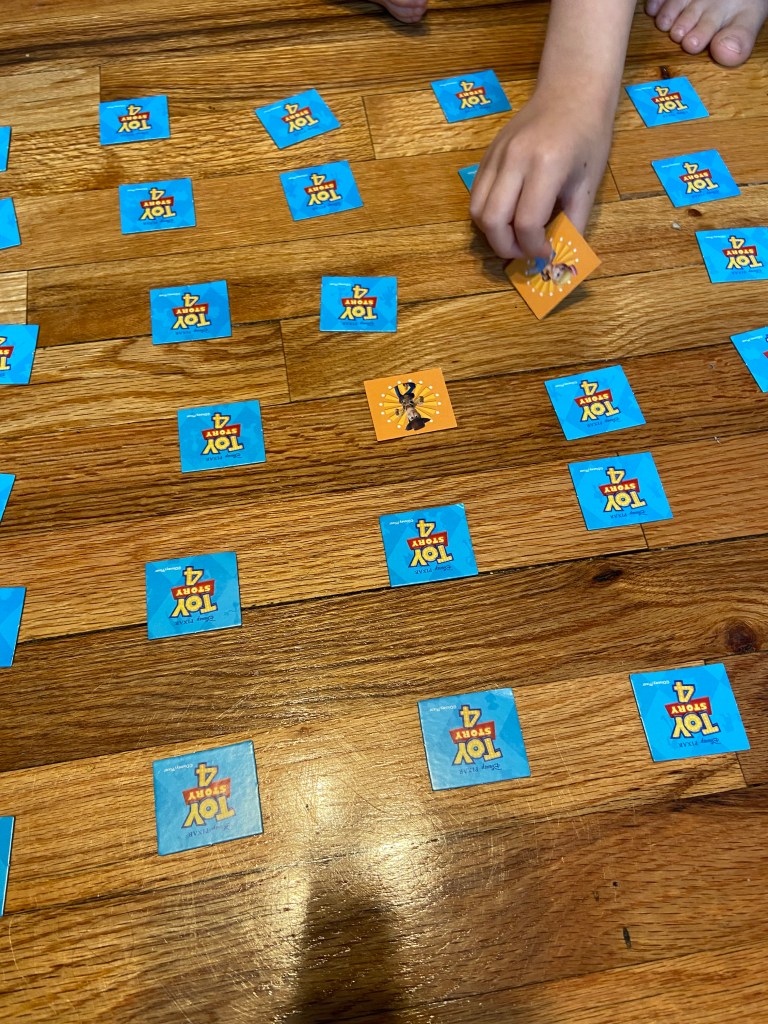
    We finished things up with a Toy Story matching game!

    Day 1 was a success and they were excited to see what was in store for Day 2! Stay tuned for more!

    School May Not Look Like You Imagined: Part 4

    A Pandemic

    In this series, I’ve talked a lot about J in Kindergarten. There was something else that happened that year which affected all of us: Covid.

    In the days leading up to March 13th, we started hearing about some local schools closing as Covid cases were rising. We wondered if our school would follow along and second guessed even sending him in the meantime.

    On Friday, March 13th, I picked J up from school. He was sent home with a packet of work and some login information for various websites as a “just in case.” At 5:00, we received a call that the school district would be closing for the following week. On Monday, the announcement came that they wouldn’t return until the end of March. As we all now know, in person learning was done for the year.

    I’m thankful J had the teacher he did and that we are a part of an amazing school district. There were calls, emails and constant communication. Teachers sent out materials, websites, calendars with suggested activities and learning to get everyone through this time. In April, the staff got together and did a neighborhood parade where they drove through the district, honking the horns of their decorated cars and putting smiles on everyone’s faces. J was so excited to see his teacher again. It brought tears to my eyes.

    In May, the staff from the High School drove around placing “Class of 2020” signs in front of the homes of the seniors. We have neighbors that were a part of this and I completely lost it watching the parents and kids hugging as the signs were placed. This was such a crazy time for all kids and senior year is supposed to be the best year. The class of 2020 had it cut short and turned upside down.

    We spent the summer wondering what school would look like once Fall came. What decisions would the school make? What decisions would we have to make?

    Ultimately the school decided to offer two options. The first was a hybrid model. You could send your child in twice a week (3 days every other week) and on the days they were home, they would learn remotely. The second was a fully virtual model, which is what we chose.

    J works best when he’s in a routine and knows what to expect each day. We felt the back and forth of the hybrid model, coming off of a year of tough drop offs, would have had a negative impact. Although learning virtually would be new and have an adjustment period, at least it was consistent.

    Prior to the holidays, J’s school returned to a full in person model, for those that were interested. If we had sent J back, he would have had to start with a new teacher, in a new class. This was also around the time that cases were once again rising. We decided to keep him virtual. As the year went on, the option to send him back remained open. There were kids from his class that went back and kids that had been in person, that joined his virtual class. The constant uncertainty among parents was clear. Everyone had to make decisions that worked best for their family.

    We’re now weeks away from the last day of 1st grade (I can’t believe it)! J did amazing with virtual learning, probably too well. I have no words for all that his teacher did for a large class of remote learners. He had a schedule of google meets throughout the day, independent work and extra work if he was up to it. He is always up for extra work. Since Kindergarten, he has always created his own “extra homework.” He’s reading almost two grade levels ahead of where he is and has learned so much this year. There was an adjustment period in the beginning of not wanting to see himself on the screen during his google meets, not wanting to talk in front of everyone, etc. That went away quickly and he now loves to participate.

    No one could have predicted the craziness of the 2020/2021 school year. I’m so thankful to teachers everywhere that went above and beyond for an experience no one was prepared for. Parents – you all made it through! The days were long and sometimes stressful, but we did it!

    J’s school is Kindergarten through 2nd grade. His first year was cut short and now he’ll be returning in September for one year before moving on to a new school. It makes me sad that he didn’t get the normalcy and the amount of time he could have in a school we love.

    Sometimes it’s not about sensory processing or anxiety, sometimes school doesn’t look like you imagined because of circumstances outside the home. The same can be said for parenting. We need to remember to expect the unexpected, go with the flow, do the best we can and take things one day at a time.

    School May Not Look Like You Imagined: Part 3

    Taking the School Bus

    Back in my day, there were walkers and bussers. Walkers were the kids who lived too close to the school and didn’t qualify for bus services. Bussers, well that one is obvious. I was a walker.

    When registering ‘J’ for school, we had to sign forms for him to take the bus and were told we would receive a bus pass prior to school starting. I asked if I was able to drive him myself or if he was required to take the bus. The woman was taken aback by the question and said of course I could take him but that every child had the ability to take the bus.

    I knew ‘J’ would never go for it.

    We did try though. We talked to him about it and asked if he wanted to try. It was a big no. At the time, his sister was 2 and stated “I’m gonna take the bus when I go to school!”

    We figured we would start the school year with me bringing him, and maybe once he saw friends taking the bus, he would want to as well. One day he finally agreed to take it home from school. This was huge!

    I received a message from his teacher saying that he started to cry once he realized it was time to line up and walk out to the bus. She let me know his friends consoled him and all chanted his name. This made my heart melt. Once they got outside, the Principal and Vice Principal were also cheering him on. He went onto the bus in tears.

    My biggest fear was that he’d try to run. When faced with fight or flight, he typically choose flight. We had prepped him leading up to it; we would meet him at the bus stop and he should not to get off the bus until he saw us. But we were still a bit nervous.

    My husband, J’s sister and I all went to the corner to wait for him. We were talking to a neighbor when we heard honking, we look over and the bus had pulled up right in front of the house. We ran over and he walked off the bus in a pile of tears and sniffles. He did it! He rode the bus! Something he was so nervous about but he made it through.

    He made it clear he never wanted to do it again.

    The only other time he has taken the bus since that day was for his only field trip. They went to see a stage show of Frosty the Snowman. He sat next to his teacher and did great. I think being with his whole class, having the comfort of his teacher there and knowing I was picking him up once he returned to school helped to make that bus ride a whole lot easier.

    Truth be told, having never taken a school bus myself (except for field trips), I was totally fine with the idea of picking him up and dropping him off. I just want him to always know the option is there for more independence. If he changes his mind one day and wants to ride the bus with his friends, we will support it. If not, that’s ok too.

    In the final part of this series, I will discuss our experience with school closing due to Covid.

    School May Not Look Like You Imagined: Part 2

    Holiday Assemblies

    I hate attention. I say this as someone who co-hosts two podcasts and does YouTube Lives. Guess you could say I’m a bit of an introvert/extrovert. When I was in school, I never liked public speaking, performing in a play, answering questions just in case I was wrong even when I knew I was right, etc. I was way too nervous. A little shy. Was there more to it than that? The early stages of my own anxiety? Probably.

    I mentioned in the previous blog how much ‘J’ loved Kindergarten and that is 100% true. HOWever, once he started practicing for his Holiday Assembly, things started to shift. Especially when he went into the auditorium for rehearsals. The size of the stage, the bright lights, the echo, he was not feeling any of it. He didn’t want to sing the songs he had been singing all month long in and out of school. He didn’t want to be up on stage in front of everyone, he wanted nothing to do with it.

    On the day of the performance, it was an extra hard drop off. His teacher was amazing and in the days leading up to it, she told him that he could stay with her until he was comfortable to go up on stage. Since this was December, 2019, we were able to go to the school to watch. There would also be a gingerbread house decorating activity after the performance for families.

    The three of us walked into school to sign in for the show. I looked down the hall to ‘J’s” classroom, his teacher made eye contact with us and waived us down. I knew things weren’t good. We walked down to the end of the hallway to his classroom and saw him behind a desk, eating a graham cracker with puffy eyes. His friends were around him, checking in on him and telling him everything would be ok. He looked up to see us and ran right into my arms crying. All four of us went to the auditorium together and took our seats, right in front of the stage, behind his teacher.

    His class walked in and took their spots on stage. We asked him if he wanted to go up with them and he said no. His teacher asked if he wanted to sit next to her and he said no. He stayed on my lap the whole time, watching his friends sing the songs he grew to love.

    The thing about ‘J’ is, when he gets himself worked up to the point of not participating in something, he never feels like he’s missing out. He feels relieved, happy and content. He was happy to be watching his friends and cheered them on. Afterwards, we were all at one long table, building gingerbread houses together and all his anxiety was lifted. He returned to the happy boy he is, laughing with his friends.

    Our heart breaks watching him struggle with new situations. His anxiety spikes, he wants to run away, he cries. As parents, we want the best for him and for him to be able to branch out and try new things. At the same time, he knows what he likes and what makes him comfortable. Sometimes he does need that nudge, like going into school. But other times, if something is overwhelming him to the point of tears, is it worth the push? We’ve seen the outcome of that and it’s typically not good.

    Seeing your child on stage for the first time may be something you’ve thought about with excitement. And it may turn out exactly how you imagined. But there is that chance that it just may not go according to plan.

    In Part 3, I’ll chat about taking the Bus.