Time to head back to school! Which means it’s also time to share some of my older posts regarding some of our school experiences! Check them out and let me know how this time of year is going in your homes!
Time to head back to school! Which means it’s also time to share some of my older posts regarding some of our school experiences! Check them out and let me know how this time of year is going in your homes!
Although I’m a bit late with this year’s post, we are still in October which means it’s Sensory Processing Awareness Month!
If you’ve spent any time on my blog, you know sensory processing disorder (SPD) is a topic close to my heart. It’s something that shapes our daily lives, from the way we plan our days to how we navigate public spaces, and even how we handle the unexpected.
For those who may not be familiar, Sensory Processing Disorder is a condition where the brain has trouble receiving and responding to information that comes in through the senses. Imagine living in a world where bright lights feel like they’re burning your skin, loud noises pierce your ears like sirens, or even a hug feels overwhelming. That’s what it’s like for many individuals with SPD.
But here’s the thing—everyone experiences sensory input differently, so SPD manifests in many different ways. Some may be hypersensitive, others may seek out sensory input, and some fluctuate between both extremes.
Our family’s journey with SPD hasn’t been based on one specific thing. It was many pieces of a puzzle that when put together meant that being bothered by a tag on a shirt wasn’t about the specific tag. We’ve learned that sensory overload isn’t just about loud noises or bright lights—it can be the little things, too. Things that might seem inconsequential to someone without SPD. For example, socks with seams or a jacket that feels “wrong” can make or break a day. These are the types of things that many people don’t even think about, but for those with SPD, they can feel monumental. It was all part of a bigger picture. Learning more about sensory input, how the brain works and how everyday things that we take for granted can be so challenging for those with sensory processing difficulties, has shaped the way we look at our everyday life.
Resources like The Star Institute, Sensory Spectacle, reading books or following social media accounts like Sensory Processing Disorder Parent Support has helped in expanding our understanding.
I wanted to take a moment to share a few things that have helped us manage day-to-day life with SPD. Of course, every child is different, but these strategies have been game-changers for us:
Every person with SPD experiences the world uniquely, and that deserves recognition.
I hope that by sharing our experiences, I can help shed some light on what it’s like to navigate life with sensory processing disorder and offer a bit of encouragement to other parents who may be feeling overwhelmed or alone on this journey. We may not have all the answers, but we’re learning everyday.
Happy Sensory Processing Awareness Month!
Did you know the Tech Life Inner Circle Membership, created by Joan Green, with over 35 years of expertise, offers a supportive community for those seeking to enhance their technological proficiency? Members gain access to live office hours, tech challenges, and webinars that focus on innovative strategies for improving organization, productivity, communication, and social engagement. Joan regularly invites experts in the fields of accessibility, aging, special needs, learning, and productivity to provide diverse perspectives and specialized knowledge. This membership offers tools and insights for effectively integrating technology into daily life, catering to both personal and professional growth. It’s an ideal resource for anyone looking to navigate the complexities of modern technology with expert guidance.

This program is ideal for:
Click here to learn more and to join the Tech Life Inner Circle with Joan Green!
During the 2020 Holiday Season, I got to interview the one and only Santa Clause on the Dillo’s Diz Podcast. With still so much uncertainty surrounding us, it was a comfort to be speaking with someone so magical. Aside from the huge honor of interviewing him, we were also chatting about VisitSantaOnline.com, where families could book a zoom call with the big guy himself!
We had been to visit Santa in person in previous years when the kids were in the baby/toddler stage. Since some time had passed, they were feeling a little nervous about seeing him in real life. As we all know, 2020 was a time where not many things were happening in person. The combination of these two factors had me running to this new way to connect with St. Nick!

The visit was amazing! Santa connected with both kids, who were 3 and 6 at the time, and brought Christmas magic to life. He was able to chat with them about some of their wishes for Christmas, school and more. 3 years later, they have continued to talk about it and we decided to book another call with Santa.
With 5 days left until Christmas, we appreciated Santa finding time out of his busy schedule to once again chat with us. Now at 9 and 6, the kids were once again star struck seeing him again. Another magical memory has been made.
If your child is a bit skiddish about meeting Santa in person, if a mall setting would be too overwhelming, or maybe scheduling an in person meeting is tough, I highly recommend checking out VisitSantaOnline.com. You get time to chat with Santa and a recording of the zoom call once it’s done. It’s a fantastic experience!
Thankful for the Christmas season, for watching magic through my kids’ eyes and for Santa as he creates memorable moments!

Holidays can be a stressful time for all of us. Some of that stress is fun and exciting, but for some people it can be completely overwhelming. Last year, I wrote about how my son asked the question “why is Christmas so overwhelming?” You can read that blog by clicking here.
Feeling comfortable and happy this time of year means creating a welcoming environment, especially for those with sensory processing difficulties. In the past, I’ve talked about the great resource that is Sensory Spectacle. Becky Lyddon has a podcast and recently talked about helpful tips around the holidays. I’m linking it here for those that are interested.
October is #SensoryProcessingAwarenessMonth! If you have a website, blog, YouTube channel, podcast, store or you provide a service to the community and would like to be featured on my blog, email me at: justmymomsense@gmail.com!

For the last few days I have been directing you to a variety of links to the Star Institute website. There are so many great resources out there and I need to to be showing them more love! For the final day of this series, I just want to direct you to the entire site. Check it out, look around and check out all of their amazing resources!
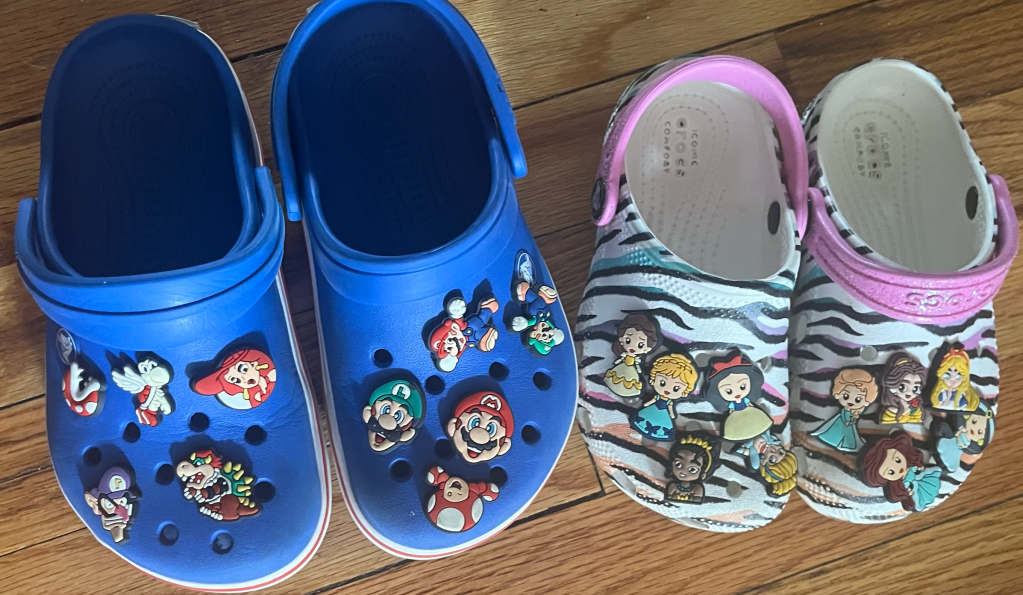
Believe it or not, this summer is our first experience with Crocs.
My 6 year old really wanted them and while shopping around for them, my 9 year old decided he wanted them too. They each found a pair they liked and put them on in the car.
My 9 year old had a sense of calm come over him and couldn’t stop talking about how much he loved the way the shoes felt on him. He didn’t want to take them off and asked if he could sleep in them. The texture, the air flow, it was all a plus for him.
My 6 year old didn’t love the texture under her feet and wanted to keep socks on with them. She kept talking how it was bumpy and felt weird. Since then, she mostly wears them with socks and loves them.
It was the sensory experiment I didn’t realize I was conducting. I didn’t expect Crocs to have such an effect on them. They also really wanted to decorate the shoes. My 6 year old got some Princess pins for hers and my 9 year old got some Mario pins for his. They wear them daily and love them.
It’s a great reminder of how little things can have a bigger impact when it comes to living a sensory life. They were able to personalize shoes that brought a lot of comfort and calm to one and happiness to the other.
The Princess Crocs pins we ordered are no longer available, but I found a similar bunch: https://amzn.to/45gC54D
If you have a Mario fan in your life, here is a link to the ones we purchased: https://amzn.to/44OXt0u
If you’re interested in trying out Crocs for yourself, click here: https://amzn.to/3Oqdfsf
Just My MomSense is a participant in the Amazon Services LLC Associates Program

Raise your hand if you’re a mom of picky eaters 🙋🏻♀️
When my kids were babies, I mushed up everything, poured it into the ice cube tray to be heated up later and made sure those infants heading towards toddlerhood were getting a well balanced meal.
My 9 year old has always been great with fruits and veggies. He has remained pretty consistent when it comes to meat: a burger patty (no bun) or chicken nugget. My 6 year old used to eat every type of food and sauce, including half a dozen baked clams one Christmas Eve when she was almost 2. I’m not sure when the switch happened but it happened in a flash.
I can easily make a list of the foods each child will eat, because it’s not that long. I try to make sure they’re getting calcium, protein and vitamins but I’m not always successful. I try to change things up like giving them a crunchy lunchy (I don’t think I’ve done a blog on this…maybe just an Instagram post…I’ll work on that).
Trying new foods is a tricky business. If you’ve read this blog before, you know that I’m very aware of how sensory integration is playing a part in whatever we do. At home, I will give them new foods to try, on a plate with food I know they like. I don’t do it constantly, I try foods more than once and see if I can get them to nibble something they never have before. When I say nibble, that’s usually what it ends up being…a nibble.
I do not have them try new foods at a family member’s house, a friend’s house, on vacation, in school or in any other location outside the home. That is not to say they can’t or that I don’t ask if they want to. Of course they’re allowed and of course we offer. In a new or unfamiliar place there are different sounds, different crowds, different lighting, different smells, more pressure from other people watching and the list goes on. If they’re already picky eaters or hesitant about trying something new, this is probably not where we’re having a breakthrough. However, they have been known to try new things on their own in Disney World. It’s probably the pixie dust they sprinkle in the food.
They bring their lunch to school everyday but also have money on their card in case they want to try something from the cafeteria. They know that if we’re at a restaurant, at someone else’s house or on vacation they can try something new or what is being served. They also know that their options may be limited but that we’ll typically be able to find something for them. And as long as they eat SOMEthing in these locations, it’s a win.
When in doubt: having healthy snacks on hand is always helpful.
Will they come around to different foods as the years are on? Maybe. Will it not happen until they’re an adult? Possibly. What we don’t want is for them to feel forced or feel uncomfortable when it comes to food.
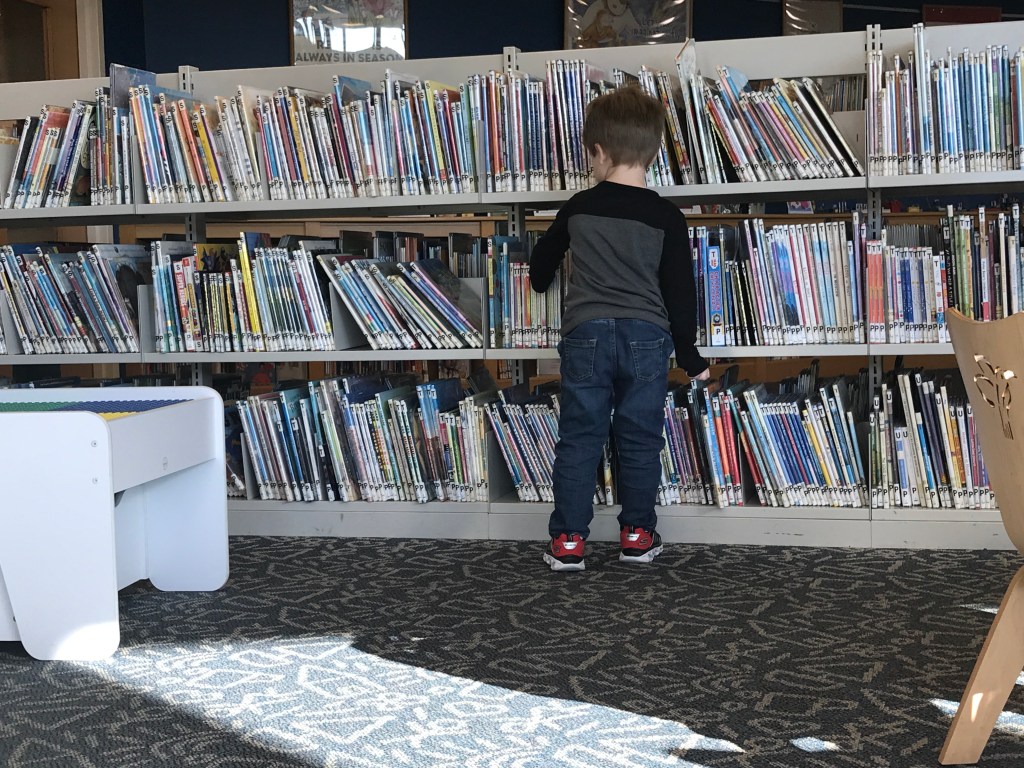
If you follow my @justmymomsense Instagram, then you have definitely seen some our library hauls.
Each of my kids got their first library card at around 6 months old. Our library is so awesome. They offer classes from the baby stage all the way up to classes for adults. Their children’s book section is extensive and it also fills the void that Blockbuster left by giving us the ability to take out DVDs and video games.
I love the love for reading that my kids have. They’re excited to pick out books and look forward to having new ones in the mix.
We’ve spent time making reading forts.
We’ve taken things outdoors in order to read on the trampoline.
Reading before bed is always fun since my husband is good at providing some of the character voices.
Along with gym, music and art, my kids also go to their school libraries once a week. They learn about new authors and are able to bring a book home from that library as well.
I am grateful for the library and schools we have. I know what a privilege it is for my children to be able to have access to so many wonderful authors, stories and opportunities.
If have a library card, you may be able to access apps in order to take out books virtually and have them sent to your Kindle or iPad. Apps like Libby are also available to read books on different devices. (This isn’t an ad, just something we’ve used)
Growing up I liked book stores and I remember having favorite authors, but I wasn’t always able to get lost in stories. I remember setting up a reading nook in my room to help give me that nudge I was needing, which probably only worked for a short amount of time. I think it’s awesome that my 8 year old loves reading new books, writing fan fiction and draws his own illustrations. My 6 year old is in Kindergarten and has come so far with reading in the last few months, it’s been amazing to watch her growth.
And now for my unsolicited advice: if you have access to a library, please get yourself and your child a library card and read with them. One of the coolest things you’ll experience is sharing a story together. That may look like you reading to them, them reading to you or just looking through pictures. However it’s done, enjoy those moments!
I’ve included some of our favorite children’s book authors over on my “These Are A Few Of My Favorite Things” page which you can check out by clicking here.
 Just My MomSense