When the Holidays Are Too Much: Navigating Anxiety & Sensory Overload as a Family

Although the holiday season can be magical, joyful, and full of tradition, it can feel loud, overwhelming, unpredictable, and exhausting. If this sounds familiar, you’re not alone.

On my latest Just My MomSense podcast episode, I talk more about why the holidays can be so overstimulating, how anxiety and sensory challenges feed into each other, and what we can do to help our kids (and ourselves) move through the season with more calm.

You can listen here or on your favorite podcasting platform!

Rising Together: How Mark Ingrassia Is Using Special Ed Rising To Empower Families and Educators

If you’ve ever felt overwhelmed navigating the world of special education, you’re not alone. This week on the Just My MomSense podcast, I talk with Mark Ingrassia, the heart and voice behind SpecialEdRising.com, to talk about his inspiring journey and mission to uplift families, educators, and students everywhere.

Mark is a passionate advocate and educator who has dedicated his career to supporting children with diverse learning needs. Through his podcast and website, Special Ed Rising, he’s built a safe and welcoming space for conversations about inclusion, advocacy, and understanding.

In our episode, Mark shares his journey into the world of special education, the lessons he’s learned along the way, and the inspiration behind Special Ed Rising. We also talk about the importance of community and how support, understanding, and a shared mission can make all the difference for children and the adults who champion them.

🔗 Listen to the Episode

For more about Mark’s work, visit SpecialEdRising.com and follow Special Ed Rising on social media.

Understanding Different Types of Therapy for Kids and Families

This household is very pro therapy! However, it’s so hard to know where to start, what the different types of therapies mean and what may be best for you or your child. With it being Sensory Processing Awareness Month, I thought I would explore the many types of therapy available for children and families; from occupational and speech therapy to CBT and talk therapy.

Occupational Therapy (OT)

Occupational Therapy helps kids build the skills they need for everyday life, from tying shoes and brushing teeth to regulating their emotions.

Common goals:

  • Improving fine and gross motor skills
  • Building independence with self-care
  • Supporting emotional and sensory regulation

Speech Therapy

Speech therapy goes beyond pronunciation. It can also help children who struggle with communication, social interaction, and feeding.
Speech therapists work on everything from articulation and expressive language to understanding nonverbal cues.

Common goals:

  • Improving clarity and confidence in speech
  • Strengthening language comprehension
  • Supporting social communication and pragmatic skills

Physical Therapy (PT)

Physical therapists help children build strength, balance, and coordination. This therapy is especially beneficial for kids with developmental delays, low muscle tone, or motor planning challenges.

Common goals:

  • Increasing strength and endurance
  • Improving posture and balance
  • Building coordination for daily tasks and play

Play Therapy

Play therapy uses play, a child’s natural form of expression, to help them process big feelings and experiences. It can be especially effective for children who have anxiety, trauma, or difficulty expressing emotions verbally.

Common goals:

  • Building emotional awareness
  • Developing coping and problem-solving skills
  • Strengthening trust and communication with caregivers

Cognitive Behavioral Therapy (CBT)

CBT is a type of talk therapy that helps children (and adults) recognize negative thought patterns and replace them with more positive, realistic ones.
It’s a powerful tool for anxiety, depression, and emotional regulation. Therapists often use visual aids, role-play, and journaling to make CBT age-appropriate and engaging.

Common goals:

  • Managing anxious or negative thoughts
  • Building resilience and confidence
  • Developing coping strategies for real-life challenges

Talk Therapy

Talk therapy provides a safe, judgment-free space for both kids and parents to explore feelings, relationships, and stressors. For parents, it can also be an invaluable form of support when navigating a child’s diagnosis or behavioral challenges.

Common goals:

  • Reducing stress and overwhelm
  • Improving communication within families
  • Processing emotions in a healthy, supported way

Feeding Therapy

Feeding therapy helps children who struggle with eating, whether due to sensory sensitivities, oral motor challenges, or anxiety around food.
A therapist might use gradual exposure, play, and desensitization to help make mealtime more positive and successful.

Common goals:

  • Increasing comfort with new foods
  • Building safe swallowing and chewing skills
  • Reducing mealtime anxiety and power struggles

Parent and Family Therapy

Therapy isn’t just for kids, it’s for families, too. Parent coaching or family therapy can help improve communication, set boundaries, and strengthen relationships.

Common goals:

  • Building teamwork between caregivers
  • Creating consistent routines
  • Understanding and supporting each child’s needs

Therapy isn’t a one-size-fits-all solution. Every child and every family is unique. What matters most is finding the right combination of support that meets your child where they are.

Whether it’s OT for sensory needs, CBT for anxiety, or play therapy to help your child open up, each form of therapy is a step toward greater understanding, connection, and confidence.

Sensory Seekers

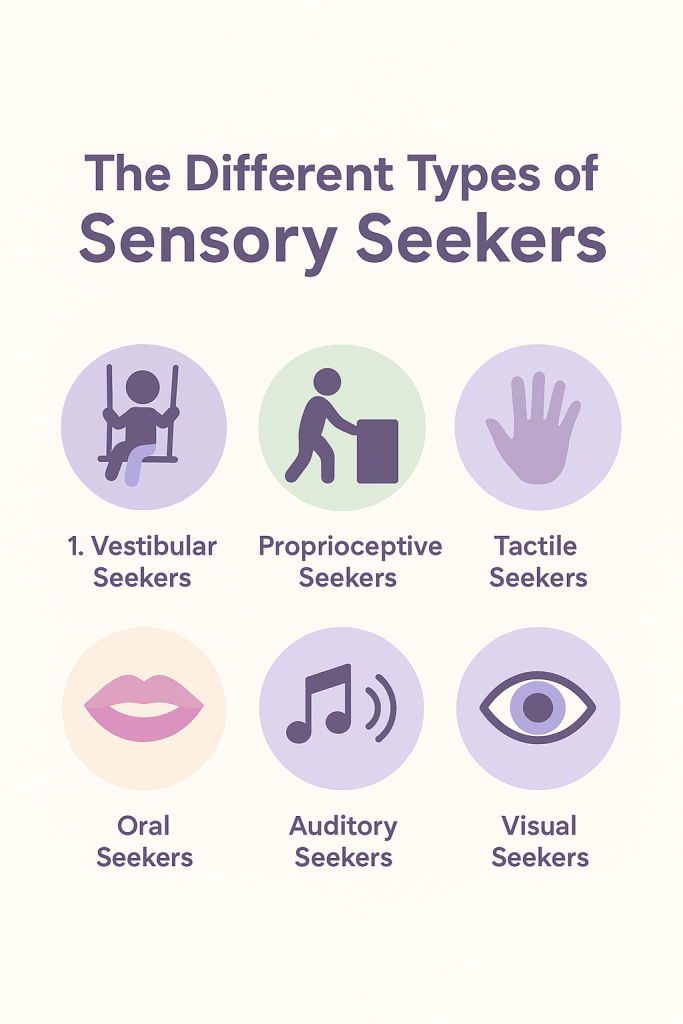
Let’s talk about sensory seekers. While some people are more sensitive and may avoid sensory input, sensory seekers are the opposite. Their nervous systems crave more input in order to feel calm and regulated. Understanding the different types of sensory seekers and the sensory systems involved can help us better support kids and adults who are wired this way.

Vestibular Seekers

The vestibular system is all about balance and movement. Vestibular seekers crave activities like spinning, swinging, jumping, or running. They’re often described as “on the go” and may have trouble sitting still. Safe outlets include trampolines, swings, or dance breaks throughout the day.

Proprioceptive Seekers

The proprioceptive system helps us sense our body position through muscles and joints. Proprioceptive seekers love heavy work and deep pressure. You might see them crashing into furniture, giving tight hugs, or lifting and carrying heavy objects. Support them with weighted blankets, obstacle courses, or tasks like pushing a laundry basket or carrying groceries.

Tactile Seekers

The tactile system processes touch through the skin. Tactile seekers are drawn to textures and physical contact. They might touch everything around them, love messy play, or constantly seek hugs. Activities like sensory bins, playdough, water play, and textured fabrics can help meet their needs.

Oral Seekers

The oral sensory system processes input through the mouth. Oral seekers may chew on pencils, bite clothing, or prefer crunchy and chewy snacks. Chewable jewelry, straws, gum, and snack options like pretzels or apples are safe ways to provide oral input.

Auditory Seekers

The auditory system interprets sound. Auditory seekers often hum, tap, or make noises. They may love music, loud environments, or playing with instruments. Consider drumming, rhythm games, or music breaks to meet their sensory needs.

Visual Seekers

The visual system processes light and movement. Visual seekers are drawn to bright lights, colors, and moving objects. They may love light-up toys, spinning fans, or repeated video clips. Glow sticks, bubble tubes, and lava lamps are great tools for visual input.

Recognizing which sensory systems a child or adult seeks can help redirect behaviors into safe and supportive outlets. Instead of labeling them as restless or disruptive, we can see their actions as communication.

Supporting sensory seekers isn’t about stopping the need for input, it’s about understanding and meeting it in a way that helps them thrive.

Reminder: Sensory Processing Difficulties aren’t kid-specific. It’s not something that goes away with age. There are ways to learn how to manage and support the day-to-day challenges and there are many adults that need support as well.

Quick Tips for Sensory-Friendly Theme Park Travel

If you’re a parent or caregiver of a neurodivergent child, the thought of visiting a theme park can feel both exciting and overwhelming. Between the crowds, the noise, and the unexpected moments, there’s a lot to navigate. But here’s the good news: with the right tools and preparation, places like Disney World, Universal Orlando, and Legoland Florida can be magical for our sensory-sensitive kiddos.

In the latest episode of the Just My MomSense Podcast, I’m sharing some quick tips and tricks I’ve learned from traveling to these parks with my kids. Whether you’re planning your first big theme park adventure or want to improve the experience for your family, this episode is for you.

Listen to the full episode here or on your favorite podcasting platform!

To go along with the episode, I’ve created a printable Sensory Friendly Vacation Prep Kit available now in my Etsy shop:

  • Visual Schedule Cards to help kids understand the flow of the day
  • My Day” prompt sheets to prep for big outings
  • I Did It!” badge to celebrate bravery
  • I Need a Break” card for when communication gets tough

Grab the kit here on Etsy

There’s no one-size-fits-all when it comes to sensory needs and that’s okay! What matters most is meeting your child where they are and giving yourself grace as you go. Theme parks can be a great experience for you and your family.

Have a favorite sensory travel tip? A must-visit quiet spot at a park? Share in the comments or send me a message I’d love to hear from you!

Embracing Neurodiversity | A Conversation with Dr. Matt Zakreski

On the most recent episode of the Just My MomSense Podcast, I had the absolute joy of speaking with Dr. Matt Zakreski. Dr. Matt is a clinical psychologist who specializes in neurodiversity, giftedness, and mental health for kids and teens.

As parents, especially those raising neurodivergent kids, we’re constantly seeking guidance, tools, and a little reassurance that we’re not alone. Dr. Matt brings all of that and more. Whether your child is diagnosed with ADHD, autism, sensory processing differences, or is simply a big-feelings kid who processes the world differently, then this episode is for you.


What Is Neurodiversity?

Neurodiversity is the concept that neurological differences, like ADHD, autism, dyslexia, and others are natural variations of the human brain, not deficits. Dr. Matt breaks it down beautifully in this episode, reminding us that being neurodivergent doesn’t mean something is wrong. It means your brain works differently and that difference brings value.


Strengths-Based Parenting for Neurodivergent Kids

Dr. Matt is passionate about focusing on what your child can do, rather than just what’s hard for them. Instead of seeing a meltdown as “bad behavior,” it’s about understanding what’s underneath, whether it’s sensory overload, anxiety, or an unmet need.

He shares strategies for:

  • Building emotional regulation skills
  • Creating safe, affirming environments at home and in school
  • Encouraging self-advocacy in neurodivergent children

Navigating School and Advocacy

A big part of our conversation centered on school and Dr. Matt offers practical advice for:

  • Talking to teachers and schools about your child’s needs
  • What to look for in an inclusive education environment
  • How to advocate

Listen Here!

Also available on your favorite podcasting platform.


Connect with Dr. Matt Zakreski

Visit his website: drmattzakreski.com
Follow on Instagram: @drmattzakreski

Fly Like You, Not Like Them

*movie spoilers ahead.*

I just finished watching The Wild Robot and so many lines stuck out to me, especially one from Fink the Fox: “Fly Like You, Not Like Them.”

When Roz arrives on an island filled with wary animals, she’s immediately seen as an outsider. She doesn’t speak their language, doesn’t understand their ways, and certainly doesn’t belong; at least, not in their eyes. It’s a situation that many kids (and adults) experience daily, whether due to neurodivergence, disability, or simply being different from the majority.

At first, Roz tries to stay hidden. She watches, listens, and slowly learns how to communicate in a way that makes sense to the animals. She doesn’t try to become them but she does adapt to her environment, while also staying true to herself.

How often do kids feel they need to change who they are just to “fit in”? Roz never stops being a robot. She doesn’t become an animal. However, she ends up becoming an important part of the island community. That’s a lesson so many of us need to remember for ourselves and our kids, right? Real inclusion doesn’t come from forcing people to act like everyone else. It isn’t about erasing differences. It’s about recognizing that every individual, from a child in a classroom, to a fictional robot on an island, has something valuable to offer.

By the end of the movie, Roz is an important part of the island’s family. Her strengths are able to be utilized, while her new friends are supporting her and each other. They’ve all gone outside of their comfort zone and accepted each other’s differences. Isn’t that what we all want for our kids? To be seen, accepted, and valued exactly as they are?

Our world needs more Rozes. More people who accept others unconditionally. More opportunities for kids to be themselves. More spaces where no one is expected to “fly” like everyone else.

The best kind of world is one where we all fly like ourselves, not like them.